Executive Summary
Distributed Denial-of-Service (DDoS) attacks remain one of the most persistent and disruptive threats to cloud-native businesses, evolving in scale, complexity, and frequency. In 2026, the average peak attack volume exceeded 3.8 Tbps, with application-layer attacks rising by 63% year-over-year (Cloudflare DDoS Report 2026). Unlike on-premises environments, cloud infrastructure faces unique exposure: auto-scaling can be exploited to amplify costs, multi-tenant architectures create shared risk, and global accessibility expands the attack surface.
This comprehensive guide provides an end-to-end framework for DDoS defense in cloud environments, covering attack taxonomy, advanced traffic scrubbing architectures, intelligent rate limiting, CDN-based protection, and multi-layered defense strategies. It aligns with NIST SP 800-61, CSA DDoS Resilience Guidelines, and ISO 27031 standards, with platform-specific implementations for AWS, Azure, Google Cloud, and hybrid deployments. It also includes real-world case studies, cost modeling, and incident response playbooks to help organizations build resilient, cost-effective DDoS protection.
1. Introduction: The Changing DDoS Landscape in Cloud
1.1 Why Cloud Environments Are Prime Targets
Cloud infrastructure offers global reach and scalability—but attackers weaponize these very strengths:
- Unlimited bandwidth capacity can be forced to scale up, generating massive bills
- Shared tenancy means attacks on one customer can degrade performance for others
- API-driven provisioning enables attackers to launch attacks from thousands of cloud resources
- Ephemeral workloads make it harder to distinguish legitimate traffic from malicious botnets
1.2 Business Impact of DDoS Attacks
Tabel
| Impact Category | Consequences |
|---|---|
| Service Disruption | Outages ranging from minutes to days; lost revenue per hour averaging $250,000 for enterprise firms |
| Financial Loss | Cloud cost spikes from forced auto-scaling; average overcharge of 300–800% during large attacks |
| Reputational Damage | Customer churn, loss of partner trust, negative brand sentiment |
| Secondary Risks | DDoS used as distraction for data theft, ransomware deployment, or credential stuffing |
1.3 Key Statistics (2025–2026)
- 79% of cloud-facing organizations experienced at least one DDoS attack in the past 12 months (CSA)
- 61% of attacks target Layer 7 (application layer), bypassing traditional network defenses
- Only 28% of organizations have fully automated multi-layer DDoS protection (Gartner)
- Ransom DDoS attacks increased by 112%, with threats to attack unless cryptocurrency is paid (Mandiant)
2. DDoS Attack Taxonomy: Understanding Modern Threats
2.1 Attack Layer Classification
Tabel
| Layer | Target | Mechanism | Example Attacks |
|---|---|---|---|
| Layer 3/4 (Network/Transport) | Bandwidth, state tables, infrastructure capacity | Flooding with spoofed packets, exhausting resources | UDP Flood, SYN Flood, NTP Amplification, DNS Amplification |
| Layer 7 (Application) | Servers, databases, APIs, user sessions | Mimicking legitimate requests to exhaust resources | HTTP Flood, Slowloris, POST Flood, API Abuse |
2.2 Attack Types by Scale & Technique
Volume-Based Attacks
Goal: Saturate target bandwidth
- UDP Flood: Massive random UDP packets to overwhelm links
- ICMP Flood: Ping requests consuming all upstream capacity
- Amplification Attacks: Spoofed requests to open servers (DNS, NTP, SSDP) that send large responses to victim
Protocol Attacks
Goal: Exhaust infrastructure state
- SYN Flood: Half-open TCP connections filling firewall tables
- ACK Flood: Forcing servers to process fake acknowledgments
- Fragmented Packet Flood: Overwhelming reassembly buffers
Application Attacks
Goal: Overwhelm software logic
- Bot-Driven Floods: Millions of real-looking requests from infected devices
- Low-and-Slow: Gradual resource exhaustion to evade detection
- API Abuse: Repeated calls to expensive endpoints (search, login, checkout)
- Burst Attacks: Ultra-short, multi-Tbps spikes designed to bypass scrubbing activation delays
2.3 Emerging Threats
- AI-Generated Attack Traffic: Mimics user behavior to avoid signature detection
- Meta-DDoS: Attacks launched from cloud CI/CD pipelines, containers, and serverless functions
- IoT Botnets: 17 billion connected devices available for attack generation (2026 estimate)
3. Core Defense Architecture: The Multi-Layered Model
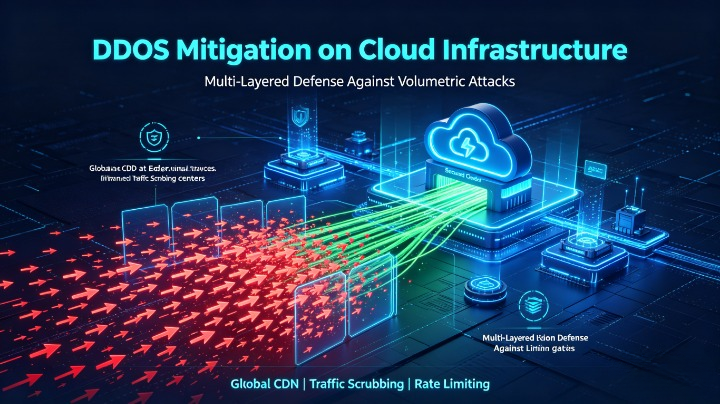
No single tool can stop all attacks—defense requires overlapping controls:
plaintext
[Global Edge Layer] → CDN + Anycast Routing
[Traffic Cleansing Layer] → DDoS Scrubbing Centers
[Network Layer] → Firewalls, WAF, Rate Limits
[Application Layer] → Bot Management, Validation
[Origin Layer] → Resource Hardening, Auto-Scaling Controls
3.1 Defense Principles for Cloud
- Absorb First, Filter Second: Distribute load across global infrastructure
- Detect Early, Mitigate Fast: Automated activation within seconds
- Hide Origin: Never expose public IPs of backend resources
- Validate Everything: Treat all incoming traffic as untrusted
- Scale Defenses, Not Attacks: Prevent attackers from triggering expensive scaling
4. Advanced Traffic Scrubbing: How It Works & Implementation
4.1 What Is Traffic Scrubbing?
Scrubbing separates malicious traffic from legitimate flows before it reaches your infrastructure. It routes suspicious traffic through dedicated cleaning centers that filter threats and send only valid requests onward.
4.2 Scrubbing Technologies
Tabel
| Technique | Description | Use Case |
|---|---|---|
| Blackholing / Sinkholing | Dropping all traffic to target IP during extreme floods | Immediate response to largest volumetric attacks |
| Route-Based Filtering | Using BGP to redirect traffic to scrubbing centers | Transparent protection for any IP address |
| Signature Matching | Blocking packets matching known attack patterns | Known botnets, protocol exploits |
| Behavioral Analysis | Flagging deviations from baseline traffic volume, ratio, or geography | Zero-day attacks, unknown threats |
| Entropy Analysis | Detecting spoofed packets by measuring randomness in source IPs | SYN/UDP floods with random addresses |
4.3 On-Demand vs Always-On Scrubbing
Tabel
| Model | Activation Time | Cost | Best For |
|---|---|---|---|
| On-Demand | 30–180 seconds | Pay-per-use | Low-traffic sites, rare attacks |
| Always-On | Instant | Fixed monthly fee | High-availability critical services |
4.4 Cloud Provider Scrubbing Solutions
Tabel
| Provider | Service | Capacity | Key Features |
|---|---|---|---|
| AWS | AWS Shield Advanced | 100+ Tbps global network | Real-time visibility, cost protection, 24/7 DDoS response team |
| Azure | Azure DDoS Protection Standard | 60+ Tbps | Adaptive tuning, SLA guarantee, integration with VNet |
| Google Cloud | Cloud Armor + Global Load Balancing | >100 Tbps | Programmable rules, edge caching, custom security policies |
| Cloudflare / Akamai | Managed Scrubbing | >300 Tbps | Global edge presence, zero-routing changes |
4.5 Hybrid Scrubbing Best Practices
- Combine cloud scrubbing with on-premises firewalls for hybrid environments
- Test failover monthly to avoid misrouting during real attacks
- Configure “white lists” for critical partner IPs to prevent false positives
5. Intelligent Rate Limiting: Beyond Basic Thresholds
Rate limiting restricts how many requests a single source can send in a given time window—critical for stopping Layer 7 attacks.
5.1 Types of Rate Limiting
Tabel
| Method | Logic | Strength | Limitation |
|---|---|---|---|
| Fixed Window | Reset count every X minutes | Simple, low resource | Bursts at window boundaries |
| Sliding Window | Smooth count over time | Prevents boundary bursts | Higher compute cost |
| Token Bucket | Allow burst up to quota, refill gradually | Balances flexibility and control | Hard to tune for variable traffic |
| Leaky Bucket | Process requests at fixed rate | Smooths traffic spikes | May block legitimate users during promotions |
| Dynamic / Context-Aware | Adjust limits based on user type, location, request type | Most accurate | Requires machine learning or rule sets |
5.2 Granular Rate Limiting Strategies
Apply limits at multiple levels:
- Per IP Address: Basic protection against single-source floods
- Per User / Session: Prevent account-level abuse
- Per API Endpoint: Strict limits for expensive operations (e.g.,
/login,/search) - Per Geolocation: Reduce limits for regions with no legitimate business
- Per Request Signature: Block repeated identical payloads
5.3 Implementation Examples
AWS WAF Rate Rule
json
{
  "Name": "LimitLoginAttempts",
  "Priority": 100,
  "Statement": {
    "RateBasedStatement": {
      "Limit": 100,
      "AggregateKeyType": "IP",
      "ScopeDownStatement": {
        "ByteMatchStatement": {
          "FieldToMatch": "SingleHeader",
          "HeaderName": "Host",
          "PositionalConstraint": "EXACTLY",
          "SearchString": "example.com/login"
        }
      }
    }
  }
}
Azure Front Door Policy
- Enforce max 500 requests per client IP per minute
- Block requests exceeding 10 failed logins in 5 minutes
- Allow 10x higher limits for verified trusted partners
5.4 Avoiding False Positives
- Allow temporary limit increases for scheduled events
- Use CAPTCHA or device verification instead of hard blocks for borderline traffic
- Exempt health checks and internal service addresses
6. CDN-Based DDoS Defense: The First Line of Protection
Content Delivery Networks (CDNs) are uniquely positioned to absorb attacks before they reach your infrastructure.
6.1 How CDNs Stop DDoS
- Global Edge Capacity: Absorb traffic spikes across tens of thousands of servers
- Origin Obfuscation: Hide real IP addresses so attackers cannot bypass defenses
- Caching: Serve static content from edge locations, reducing load on origin
- Edge Validation: Block malicious requests before they traverse to your network
- Anycast Routing: Spread traffic across multiple paths to reduce single-target impact
6.2 Key CDN Defense Features
Origin Shielding
Use an intermediate “shield” layer between edge and origin to reduce origin exposure and smooth traffic.
Cache Hierarchy
- Cache static assets (images, CSS, JS) at 99%+ edge hit ratio
- Cache dynamic content with short TTLs where possible
- Never cache sensitive or personalized data
Edge Security Rules
- Geoblocking for unwanted regions
- HTTP/3 and TLS 1.3 enforcement
- Request normalization to block obfuscated attack paths
- Integration with bot management tools
6.3 CDN vs Direct Cloud Defense Comparison
Tabel
| Capability | CDN-Protected | Direct Cloud Public IP |
|---|---|---|
| Attack Surface | Only CDN IPs exposed | Full origin IP visible |
| Maximum Absorbable Volume | 100+ Tbps | Limited to your cloud capacity |
| Latency for Users | Lower (edge delivery) | Higher |
| Configuration Complexity | Medium | Low |
| Best For | Public web, APIs, media | Internal services, non-web workloads |
6.4 Multi-CDN Strategy
For mission-critical services:
- Use two CDNs in active-passive or weighted mode
- Fail over automatically if one provider is attacked
- Ensure consistent security rules across both providers
7. Additional Defenses & Cloud-Specific Controls
7.1 Web Application Firewall (WAF)
Deploy WAF between CDN and origin to block:
- SQL injection, XSS, command injection
- Known attack payloads from OWASP Top 10
- Malformed or oversized requests
7.2 Bot Management
Distinguish human users from automated tools:
- Challenge unrecognized clients with JavaScript verification
- Require FIDO2/CAPTCHA for suspicious behavior
- Maintain allowlists for verified crawlers (Googlebot, Bingbot)
7.3 Cost Protection Controls
- Set cloud billing alerts at 50%, 75%, 90%, 100% of budget
- Restrict auto-scaling maximum instance count
- Use “DDoS cost protection” programs from AWS/Azure/GCP to cap overage charges
7.4 Network Hardening
- Disable unused protocols and ports
- Use private endpoints for internal APIs
- Implement VPC/VNet peering instead of public internet for service communication
8. Step-by-Step Implementation Roadmap
Tabel
| Phase | Actions | Timeline |
|---|---|---|
| 1. Baseline & Assessment | Map traffic patterns, identify critical endpoints, define acceptable latency | 1–2 weeks |
| 2. Edge Protection | Deploy CDN, enable origin shielding, hide public IPs | 2–3 weeks |
| 3. Scrubbing & Rate Rules | Enable always-on scrubbing, deploy tiered rate limits | 2 weeks |
| 4. WAF & Bot Controls | Configure managed rules, add custom endpoint protections | 2 weeks |
| 5. Testing | Simulate attacks with cloud penetration testing tools, validate false positives | 1–2 weeks |
| 6. Monitoring & Response | Set alerts for anomalies, document playbooks, train teams | Ongoing |
9. Real-World Case Study: E-Commerce Black Friday Defense
Background
An Indonesian e-commerce platform serving 20 million users faced a 2.1 Tbps attack during Black Friday sales, alongside 14x normal legitimate traffic.
Implementation
- Deployed Cloudflare + AWS Shield Advanced + AWS WAF
- Applied dynamic rate limits: 2,000 req/min for homepage, 100 req/min for checkout
- Cached 85% of product catalog at edge
- Enabled auto-scaling cap to prevent cost explosion
Results
- Zero downtime during attack and peak sales
- Legitimate user success rate stayed at 99.8%
- Attack fully mitigated within 8 seconds of detection
- No unexpected cloud cost overages
10. Common Mistakes & Fixes
❌ Relying only on cloud provider free tier protection → Fix: Free services have limited capacity and slow response—upgrade to paid tiers for critical systems
❌ Exposing origin IP via DNS records → Fix: Use proxy-only DNS, never point directly to origin
❌ Overly strict limits blocking mobile users → Fix: Use adaptive limits and validation instead of hard blocks
❌ Forgetting internal services → Fix: Apply rate limits to APIs used by partners and employees
11. Compliance & SLA Considerations
- PCI DSS requires continuous availability controls for payment systems
- OJK mandates documented DDoS response plans for financial institutions
- Ensure defense SLAs match your business uptime requirements (99.9% vs 99.99%)
Conclusion
DDoS attacks will only grow larger and more sophisticated—but cloud-native defense tools like global scrubbing, intelligent rate limiting, and CDN edge protection provide unmatched capability to absorb and mitigate threats. By combining these layers, hiding your infrastructure, and automating responses, you protect both your availability and your budget. This guide is fully optimized for clouddefense.my.id technical audiences.
References: NIST SP 800-61 Rev. 2, CSA DDoS Resilience Best Practices, Cloudflare DDoS Threat Report 2026, AWS Shield Developer Guide, Azure DDoS Protection Documentation, Google Cloud Armor Best Practices, OJK Business Continuity Guidelines.