Introduction
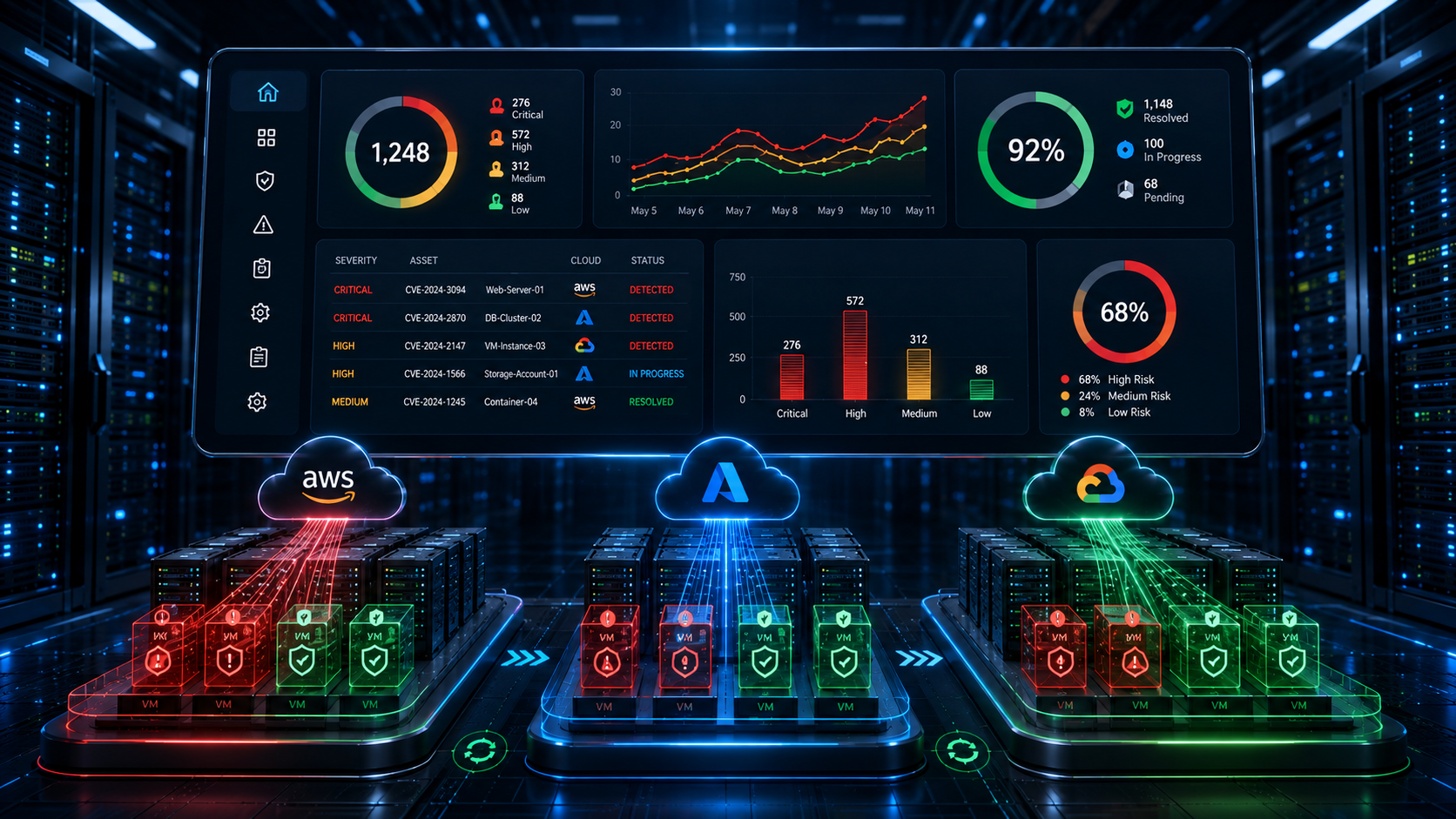
Multi-cloud environments introduce significant challenges for vulnerability management. Different clouds use separate scanning tools, patch schedules, and reporting formats. Our team has architected a cross-cloud vulnerability management system that unifies scanning, prioritization, and remediation across AWS, Azure, and GCP.
The Multi-Cloud Vulnerability Problem
Organizations using multiple clouds face:
- Duplicate scans and redundant costs.
- Inconsistent vulnerability definitions across clouds.
- Siloed reporting that prevents holistic risk assessment.
- Different patch windows and maintenance schedules.
Our Unified Architecture
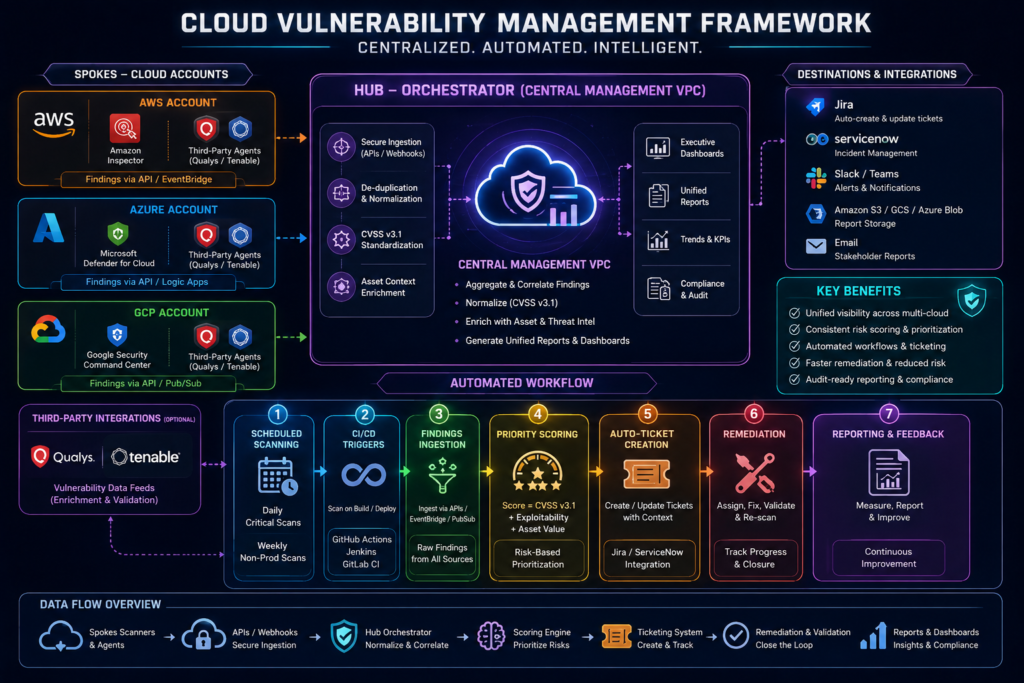
We designed a hub-and-spoke architecture where a central orchestrator coordinates scanning across all cloud environments:
Hub (Orchestrator):
- Runs on a dedicated management VPC.
- Aggregates scan results from all spokes.
- Normalizes vulnerabilities using a common classification (CVSS v3.1).
- Generates unified dashboards and reports.
Spokes (Cloud Accounts):
- Run native scanning tools (AWS Inspector, Azure Defender, GCP Security Command Center).
- Also deploy third-party agents (Qualys, Tenable, Rapid7) for deeper assessment.
- Report findings to the hub via secure API calls.
Key Components
- Unified Vulnerability Database (UVD)
We maintain a centralized database that correlates CVEs across clouds. Each vulnerability is enriched with:- Exploit availability (Metasploit, public POC).
- Cloud-specific mitigation instructions.
- Business impact (based on asset criticality).
- Automated Scan Orchestration
We schedule scans using AWS Lambda, Azure Functions, and GCP Cloud Functions. Scans run:- Daily for critical assets.
- Weekly for non-production environments.
- Immediately after new deployments (CI/CD triggers).
- Priority-Based Remediation Workflow
We assign each vulnerability a priority score combining CVSS, exploitability, and asset value. High-priority vulnerabilities trigger automated tickets in Jira/ServiceNow and notifications to responsible teams.
Implementation Steps
| Phase | Activities | Duration |
|---|---|---|
| 1 | Deploy hub orchestrator, configure APIs | 2 weeks |
| 2 | Set up spoke scanning agents | 1 week per cloud |
| 3 | Integrate with SIEM and ticketing | 1 week |
| 4 | Pilot, tune, and expand | 2 weeks |
Real-World Results
We implemented this architecture for a fintech enterprise with 3 cloud providers:
- Reduced Mean Time to Remediate (MTTR): From 14 days to 3 days.
- Eliminated Duplicate Scans: Saved $15,000 annually.
- Improved Coverage: 99.8% of assets scanned weekly.
Cost Considerations
| Cloud | Native Scanning Cost | Third-Party Agent Cost | Total Monthly |
|---|---|---|---|
| AWS | $500 | $1,200 | $1,700 |
| Azure | $400 | $1,200 | $1,600 |
| GCP | $350 | $1,200 | $1,550 |
Conclusion
A unified cross-cloud vulnerability management architecture is essential for organizations operating in multi-cloud environments. Our hub-and-spoke design centralizes scanning, normalizes data, and automates remediation across AWS, Azure, and GCP. We recommend implementing orchestration first, then expanding to full automation. This approach reduces security gaps, lowers costs, and improves compliance reporting.