

Introduction
Zero trust architecture (ZTA) is no longer optional for multi-cloud enterprises. With workloads spanning AWS, Azure, and GCP, traditional perimeter-based security models fail. Our team has deployed zero trust architectures for global clients, achieving consistent identity verification, micro-segmentation, and least-privilege access across heterogeneous cloud environments.
The Multi-Cloud Zero Trust Challenge
Each cloud provider offers different identity and access management (IAM) models:
- AWS IAM
- Azure AD
- GCP IAM
Integrating these with on-premises directories (e.g., Active Directory) requires a unified identity fabric. Additionally, network segmentation policies must translate across VPCs, VNets, and GCP networks.
Our Zero Trust Architecture Framework
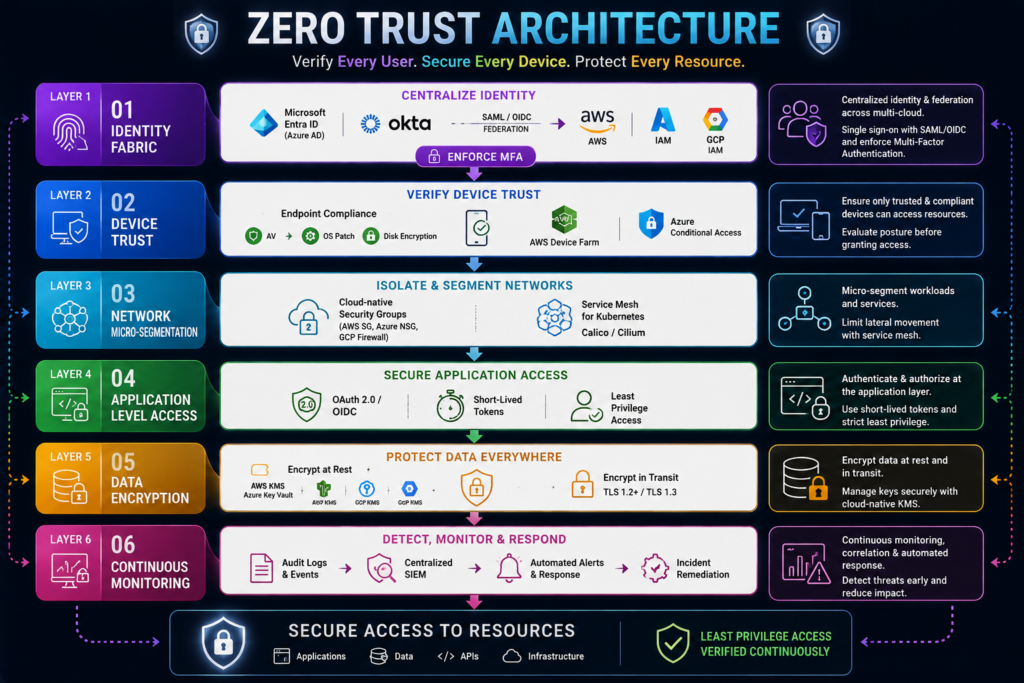
We follow a six-layer framework:
Layer 1: Identity Fabric
We centralize identity using Azure AD or Okta as the primary identity provider. SAML 2.0 and OIDC federation bridge to cloud IAMs. Multi-factor authentication is enforced for all users and service accounts.
Layer 2: Device Trust
We implement endpoint compliance checks (Antivirus, OS version, patch status) before granting access. AWS Device Farm, Azure Conditional Access, and GCP Context-Aware Access enforce these checks.
Layer 3: Network Micro-Segmentation
We use cloud-native security groups and service meshes to enforce network segmentation. Calico and Cilium provide fine-grained policies for Kubernetes clusters.
Layer 4: Application-Level Access
We enforce least-privilege access at the application layer using OAuth 2.0 and OpenID Connect. Each microservice obtains short-lived tokens with minimal permissions.
Layer 5: Data Encryption
We encrypt data at rest and in transit using AWS KMS, Azure Key Vault, and GCP Cloud KMS. Client-side encryption ensures that cloud providers cannot access sensitive data.
Layer 6: Continuous Monitoring
We monitor all access requests, authentication attempts, and resource changes using cloud-native audit logs and a centralized SIEM.
Implementation Roadmap
| Phase | Milestone | Timeline |
|---|---|---|
| 1 | Identity consolidation (Okta/Azure AD) | 4 weeks |
| 2 | MFA enforcement for all users | 2 weeks |
| 3 | Network segmentation pilot (1 app) | 3 weeks |
| 4 | Full micro-segmentation rollout | 6 weeks |
| 5 | Continuous monitoring deployment | 4 weeks |
Real-World Metrics
We measured outcomes for a retail client:
- Reduced Attack Surface: 70% fewer lateral movement paths.
- Faster Incident Response: 60% reduction in detection time.
- Compliance Improvement: Achieved NIST 800-207 alignment.
Challenges and Solutions
Challenge: IAM policy complexity across clouds.
Solution: Use infrastructure as code (Terraform) to standardize policies.
Challenge: Performance overhead of continuous inspection.
Solution: Deploy edge inspection points and use sidecar proxies for east-west traffic.
Challenge: Cost of monitoring all traffic.
Solution: Prioritize high-risk workloads and use cost-effective storage tiers.
Conclusion
Implementing zero trust for multi-cloud enterprise networks requires a phased, systematic approach. Our six-layer framework—identity fabric, device trust, micro-segmentation, application-level access, encryption, and continuous monitoring—provides a clear roadmap. Organizations that adopt this architecture reduce risk, improve compliance, and gain visibility into all cloud interactions.