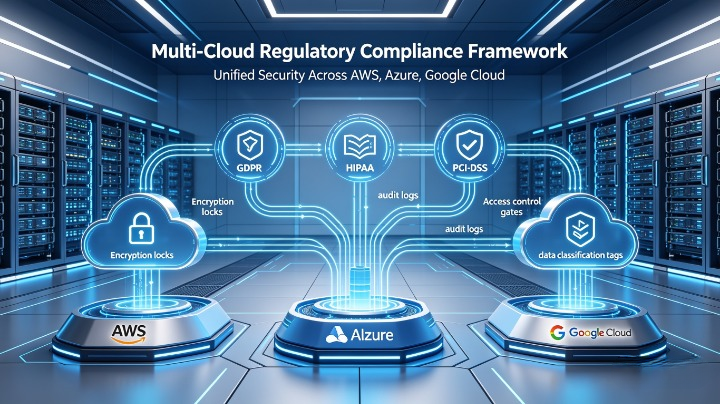
Executive Summary
As organizations adopt multi-cloud strategies to avoid vendor lock-in and optimize performance, meeting global regulatory requirements has become one of the most complex challenges in cloud security. 71% of multi-cloud deployments face compliance gaps across at least one major framework, while 44% have incurred penalties or audit findings due to inconsistent controls between AWS, Azure, and Google Cloud (Gartner 2026). General Data Protection Regulation (GDPR), Health Insurance Portability and Accountability Act (HIPAA), and Payment Card Industry Data Security Standard (PCI-DSS) impose strict, overlapping but distinct obligations—with no single “one-size-fits-all” configuration for multi-cloud environments.
This comprehensive guide breaks down mandatory security controls for each regulation, compares native compliance capabilities across leading cloud providers, and provides a unified implementation framework aligned with ISO 27001, NIST SP 800-53, and CSA Cloud Controls Matrix. It addresses cross-border data transfers, shared responsibility gaps, audit readiness, and real-world multi-cloud compliance failures to help teams build consistent, auditable, and cost-effective controls across all cloud platforms.
1. Introduction: Compliance in the Multi-Cloud Era
1.1 The Shift from Single to Multi-Cloud
- 92% of enterprises now use two or more cloud providers; 45% use three or more (Flexera 2026)
- Drivers: redundancy, specialized services, regional requirements, cost negotiation
- Compliance risk: rules applied in one cloud do not automatically carry over to others
1.2 The Shared Responsibility Trap for Compliance
Cloud providers certify their infrastructure—but you are responsible for configuring services correctly, managing data flows, and proving compliance. Common misconceptions:
- “If AWS is PCI-compliant, our workload automatically is too”
- “Azure’s HIPAA BAA means we don’t need extra controls”
- “We can copy our AWS setup directly to GCP”
1.3 Scope of This Guide
We focus on three most widely adopted frameworks:
Tabel
| Framework | Governing Body | Primary Target | Penalty Ceiling |
|---|---|---|---|
| GDPR | European Commission | Personal data of EU residents | €20M or 4% of global revenue |
| HIPAA | HHS OCR (USA) | Protected Health Information (PHI) | Up to $2M per violation + criminal liability |
| PCI-DSS v4.0 | PCI SSC | Cardholder Data (CHD) / Sensitive Auth Data | Fines, loss of card processing privileges |
2. Core Compliance Fundamentals for Multi-Cloud
2.1 Universal Principles Across All Frameworks
- Data Minimization: Collect only what is necessary; delete when no longer required
- Access Limitation: Least privilege, role separation, MFA for all privileged roles
- Encryption: At rest + in transit; customer-managed keys for sensitive data
- Auditability: Immutable logs, change tracking, proof of control operation
- Breach Response: Notification timelines, containment procedures, post-incident review
2.2 Unique Multi-Cloud Challenges
- Terminology Differences: Same control named differently across providers
- Feature Gaps: One cloud supports a requirement natively; another needs third-party tools
- Cross-Region/Cloud Data Flows: Tracking where data moves is critical for residency rules
- Fragmented Audits: Multiple providers, multiple audit reports, inconsistent evidence
3. Deep Dive: GDPR Security Controls
3.1 Key GDPR Obligations for Cloud
- Lawfulness, Fairness, Transparency: Clear purpose for processing personal data
- Data Subject Rights: Access, correction, erasure, portability, restriction
- Data Protection by Design & Default: Controls embedded from architecture phase
- Cross-Border Transfers: Only send to jurisdictions with adequate protection (SCCs, Binding Corporate Rules)
- DPIA: Mandatory for high-risk processing (e.g., large-scale health data)
3.2 Mandatory Security Controls
Tabel
| Requirement | Implementation Guidance | Multi-Cloud Notes |
|---|---|---|
| Data Classification & Tagging | Label all PII; enforce retention policies | Use AWS Tags, Azure Labels, GCP Resource Manager; align naming conventions |
| Access Control | Unique accounts, MFA, no shared credentials | Unified via Entra ID / Azure AD + IAM Identity Center |
| Encryption | TLS 1.3 everywhere; AES-256 at rest | Use CMK for PII; avoid provider-only keys |
| Breach Notification | Report to supervisory authority within 72 hours | Centralize detection across clouds; test response paths |
| Data Portability | Provide structured exports on request | Standardize export formats (CSV/JSON/Parquet) |
3.3 Cross-Border Transfer Rules
- Adequacy Decisions: Approved countries (e.g., UK, Japan, New Zealand)
- SCCs: Standard Contractual Clauses required for transfers to non-adequate regions
- Multi-Cloud Tip: Define “allowed regions” in organization policies; block transfers to restricted zones
4. Deep Dive: HIPAA Security Rule & HITECH
4.1 Scope & Key Requirements
Applies to Covered Entities and Business Associates handling PHI:
- Administrative safeguards: policies, training, risk assessments
- Physical safeguards: facility, device, media control
- Technical safeguards: access control, audit, integrity, authentication, transmission security
4.2 Mandatory Technical Controls
Tabel
| HIPAA Section | Control | Multi-Cloud Implementation |
|---|---|---|
| §164.312(a)(1) | Unique User Identification | Disable shared accounts; use SSO across clouds |
| §164.312(a)(2)(i) | Emergency Access Procedure | Document break-glass roles; time-bound access |
| §164.312(b) | Audit Controls | Centralize immutable logs; retain 6+ years |
| §164.312(c) | Integrity & Authentication | mTLS, signed artifacts, integrity checks |
| §164.312(e) | Transmission Security | No plaintext PHI; TLS 1.3 only |
4.3 Business Associate Agreements (BAA)
- You must sign a BAA with every cloud service used for PHI
- Verify service scope: not all features are HIPAA-eligible (e.g., some AI tools, public preview services)
- Multi-cloud: maintain a single BAA register listing all providers and in-scope services
5. Deep Dive: PCI-DSS v4.0 Requirements
5.1 Key Changes in v4.0
- Shift from “compliance once” to continuous security
- Mandatory custom risk mitigation for unique environments
- Stricter encryption for Sensitive Authentication Data (SAD)
- Penetration testing required for all cloud environments
5.2 Core Requirements for Multi-Cloud
Tabel
| Requirement | Detail | Multi-Cloud Critical Notes |
|---|---|---|
| 3. Protect Stored CHD | Never store SAD; truncate PAN; hash non-reversible | Use tokenization where possible; avoid multi-cloud shared storage for raw PAN |
| 4. Encrypt CHD in Transit | Strong cryptography; trusted certificates | No downgrade to TLS 1.1 or below |
| 7–9. Access Control | Least privilege; need-to-know only | Map identical roles across clouds for audit consistency |
| 10. Log & Monitor | Retain logs 1+ year; real-time alerting | Correlate AWS CloudTrail, Azure Activity Log, GCP Audit Log |
| 11. Test Security | Quarterly vulnerability scans; annual pen-test | Test all cloud environments; include cross-cloud flows |
5.3 Segmentation in Multi-Cloud
- Isolate CHD environments from non-payment systems
- Enforce network segmentation between cloud providers
- Avoid shared management accounts across segmented zones
6. Multi-Cloud Compliance Capability Comparison
Tabel
| Control Category | AWS | Azure | Google Cloud | Unified Recommendation |
|---|---|---|---|---|
| Encryption | KMS + CloudHSM | Key Vault + Managed HSM | Cloud KMS + EKM | Use customer-managed keys; align rotation at 90 days |
| Logging | CloudTrail + CloudWatch | Activity Logs + Monitor | Audit Logs + SCC | Export to single SIEM (Splunk, Sentinel) |
| Identity | IAM Identity Center | Entra ID | Cloud Identity | Single SSO source; consistent role naming |
| Policies | SCPs + Config | Azure Policy + Defender | Org Policies + Security Command Center | Write rules-as-code with Terraform/OPA |
| Residency | AWS Outposts / Local Zones | Azure Regions / Sovereign | GCP Regions / Assured Workloads | Define allowed locations centrally |
| Audit Artifacts | Artifact Reports | Compliance Manager | Compliance Reports | Collect annually; map to unified evidence library |
7. Unified Multi-Cloud Compliance Framework
7.1 Step 1: Define Compliance Scope
- List all data types and which regulations apply to each
- Map data flows between clouds and on-premises
- Identify in-scope services per provider
7.2 Step 2: Establish Control Baselines
Standardize so you don’t reinvent work:
plaintext
[Common Controls (All Frameworks)]
├─ Encryption everywhere
├─ MFA for all admins
├─ Immutable logging
└─ Data classification tagging

[GDPR Add-ons]
├─ DPIA process
├─ Cross-border transfer approval
└─ Subject request workflow

[HIPAA Add-ons]
├─ BAA management
├─ PHI breach notification (60 days)
└─ Workforce training

[PCI Add-ons]
├─ PAN truncation/tokenization
├─ Segmentation validation
└─ Quarterly scanning
7.3 Step 3: Automate & Enforce
- Infrastructure as Code: Enforce compliant configurations before deployment
- Policy-as-Code: Use OPA, Kyverno, or provider-native tools to block non-compliant resources
- Continuous Validation: Run scans daily; flag deviations immediately
7.4 Step 4: Audit Readiness
- Maintain a single evidence repository
- Map every requirement to a control, tool, and evidence source
- Run internal audits quarterly; fix gaps before official assessments
8. Cross-Cutting Risks & How to Mitigate
8.1 Data Residency & Sovereignty
- Risk: Data stored in non-compliant regions by mistake
- Fix: Use organization/SCP rules to block creation in disallowed geographies
8.2 Inconsistent Access Policies
- Risk: Admin rights granted in one cloud but not revoked in another
- Fix: Implement centralized identity governance; regular cross-cloud access reviews
8.3 Shared Responsibility Gaps
- Risk: Assuming a provider covers a control you must implement
- Fix: Create a matrix mapping “Provider Managed vs Customer Managed” for every service you use
8.4 Third-Party Integration
- Risk: SaaS tools or partner connections introduce unvetted data flows
- Fix: Mandate compliance assessment before onboarding any integration
9. Real-World Case Study: Multi-Cloud Financial Services
Background
A payment processor operates on AWS (production) + Azure (analytics), serving EU and US customers. Must meet GDPR + HIPAA + PCI-DSS.
Initial Gaps
- PHI and CHD replicated to Azure without encryption
- No consistent cross-cloud access reviews
- Logs stored separately; no unified breach detection
Remediation
- Deployed unified tagging, encryption with cross-cloud KMS
- Implemented Entra ID as single identity source
- Built Terraform modules for identical compliant deployments
- Centralized logging in Azure Sentinel with 7-year retention
Outcome
- Passed all three audits with zero major findings
- Reduced compliance preparation time by 65%
- Automated gap detection cut manual work by 80%
10. Common Mistakes & Corrections
❌ “Copy-paste” configurations → Fix: Adapt to provider capabilities but keep control objectives identical
❌ Ignoring inter-cloud traffic → Fix: Apply encryption and access checks to data moving between clouds
❌ No update process → Fix: Schedule reviews whenever regulations or cloud services change
❌ Compliance as “project” → Fix: Embed into every sprint, deployment, and change process
11. Future Trends
- Sovereign Clouds: EU, Indonesia, and other regions launching compliant national clouds
- AI Compliance: New rules for automated decision-making under GDPR
- Continuous Attestation: Real-time proof instead of annual audits
Conclusion
Multi-cloud compliance is not about meeting one provider’s checklist—it is about defining consistent security outcomes regardless of infrastructure. By aligning controls across GDPR, HIPAA, and PCI-DSS, standardizing policies, and automating validation, you reduce risk, cut audit costs, and build resilience that works across every environment you use. This guide is built for clouddefense.my.id readers including compliance officers, cloud architects, and security leads.
References: GDPR Text (EU 2016/679), HIPAA Security Rule, PCI-DSS v4.0, CSA Cloud Controls Matrix v4.0, NIST SP 800-53 Rev 5, AWS Compliance Programs, Azure Compliance Documentation, Google Cloud Compliance Resources.