Executive Summary
Cloud environments fundamentally change how security incidents unfold: resources are ephemeral, logs are distributed across multiple services, and attackers can erase traces in minutes—while traditional on-premises response methods often fail or destroy critical evidence. In 2026, 68% of cloud breaches took over 90 days to detect, and 54% of response teams lost access to vital forensic data during containment (Mandiant Global Cloud Threat Report).
This exhaustive guide builds a complete cloud-native incident response (IR) and digital forensics framework, aligned with NIST SP 800-61, ISO 27035, and CSA Forensics Guidelines. It covers cloud-specific detection signals, isolation techniques that preserve evidence, evidence collection across AWS, Azure, and Google Cloud, malware and breach analysis, chain-of-custody requirements, and post-incident recovery. It includes real-world cases, step-by-step playbooks, and tooling recommendations for organizations of all sizes.
1. Introduction: Why Cloud IR and Forensics Are Different
1.1 Key Differences Between On-Prem and Cloud Incidents
Tabel
| Factor | On-Premises | Cloud Environments |
|---|---|---|
| Evidence Persistence | Servers stay online; logs retained locally | Ephemeral instances destroyed; logs centralized or deleted automatically |
| Access Control | Full physical/console access | Limited API/management access; no direct disk/network capture |
| Shared Responsibility | You own everything | Provider manages infrastructure; you secure data, config, and logs |
| Scale & Speed | Changes happen slowly | Attackers can provision, compromise, and destroy resources in seconds |
| Multi-Tenancy | Isolated environment | Actions may impact other tenants; strict legal boundaries for evidence |
1.2 Critical Statistics (2025–2026)
- Average time to identify a cloud breach: 97 days; time to contain: 31 days (IBM Cost of a Data Breach)
- 72% of organizations lack a documented cloud-specific IR plan
- Only 22% can reliably collect full forensic evidence across multi-cloud deployments
- 41% of responders accidentally destroyed evidence during containment actions (SANS Cloud Forensics Survey)
1.3 Legal & Compliance Context
- Evidence must be authentic, complete, unaltered, and traceable to be accepted in court
- Regulations like GDPR, HIPAA, PCI-DSS, and Indonesia’s PDP Law mandate specific IR workflows and evidence retention
- Cross-border evidence collection requires legal authorization and provider approval
2. Pre-Incident Preparation: The Most Critical Phase
You cannot collect what you haven’t prepared to capture.
2.1 Mandatory Logging & Telemetry Setup
Enable these before an incident occurs:
Tabel
| Log Type | AWS | Azure | Google Cloud | Minimum Retention |
|---|---|---|---|---|
| Management/API | CloudTrail (all regions) | Activity Logs | Audit Logs | 12+ months |
| Identity Access | IAM Access Logs | Entra ID Sign-in | Cloud Identity Logs | 12+ months |
| Network Traffic | VPC Flow Logs | NSG Flow Logs | VPC Flow Logs | 90+ days |
| Runtime/Workload | CloudWatch, GuardDuty | Azure Monitor, Defender | SCC, GKE Logs | 90+ days |
| Container/Orchestration | EKS Audit/Controller | AKS Diagnostics | GKE Audit Logs | 90+ days |
Critical Rules:
- Store logs in an immutable, write-only storage bucket separate from production
- Encrypt logs at rest and in transit; restrict access to only IR/audit teams
- Use a centralized SIEM (Splunk, Sentinel, Chronicle) for cross-cloud correlation
2.2 Build a Cloud IR Playbook
Include dedicated workflows for:
- Compromised credentials/accounts
- Unauthorized resource creation
- Malware/ransomware in workloads
- Data exfiltration events
- Privilege escalation
- DDoS/availability attacks
2.3 Define Roles & Escalation Paths
- IR Lead: Coordinates all actions
- Forensics Specialist: Collects and preserves evidence
- Cloud Admin: Executes isolation/remediation under supervision
- Legal/Compliance: Validates evidence and regulatory reporting
- Communications: Notifies stakeholders and authorities
2.4 Provider Readiness
- Sign up for premium support with dedicated IR response (AWS Enterprise Support, Azure Premier)
- Maintain contacts for cloud provider security teams
- Review provider policies: what evidence they can provide, and what they cannot share
3. Detection: How to Identify Cloud Breaches
3.1 Cloud-Specific Indicators of Compromise (IOCs)
Look for anomalies such as:
- Identity: Login from unknown geolocations, impossible travel, new admin roles, service account token misuse
- Resource: Unusual instance types (high-CPU/GPU for crypto-mining), new buckets/public shares, deleted logs
- Network: Unusual outbound traffic to known malicious IPs, large transfers to external regions, unexpected port activity
- Billing: Unspending spikes, new reserved instances, unknown marketplace subscriptions
3.2 Detection Tools & Signals
Tabel
| Layer | Native Tools | Third-Party Tools |
|---|---|---|
| Threat Detection | GuardDuty, Defender for Cloud, SCC | CrowdStrike, SentinelOne, Prisma Cloud |
| Anomaly Detection | CloudWatch Anomaly Detector, Azure Smart Detection | Splunk Anomaly, Datadog Security Monitoring |
| Correlation | Security Hub, Azure Sentinel, SCC | Elastic Security, Chronicle |
3.3 Triage: Confirm True Positives
- Cross-verify with multiple sources (don’t act on one alert alone)
- Rule out false positives: legitimate deployments, testing, third-party integrations
- Classify severity: Critical (data breach/root access), High, Medium, Low
4. Isolation: Stop the Attack Without Destroying Evidence
Golden Rule: Preserve evidence first; contain second; remediate last.
4.1 Safe Isolation Techniques
Tabel
| Resource Type | Action to Take | Actions to AVOID |
|---|---|---|
| Compromised Instance/VM | Stop inbound traffic via security groups/firewall; do not terminate | Rebooting, stopping, or deleting the instance |
| Compromised Container/Pod | Isolate via network policy; take memory snapshot; do not delete | Restarting the pod or scaling down |
| Compromised IAM/User | Disable credentials; revoke sessions; keep role assignments visible | Deleting the account entirely |
| Compromised Storage | Block public access; suspend write permissions | Deleting objects or overwriting data |
| Compromised Network | Isolate subnet; block malicious IPs; enable full packet capture | Flushing routing tables or resetting connections |
4.2 Provider-Specific Isolation Steps
AWS
- Modify security groups to
Deny All Inbound; remove instance from Auto Scaling Group - Create EBS snapshot before making changes
- Revoke active sessions via
sts:RevokeSession
Azure
- Add NSG rule to block all traffic; remove from load balancer/VMSS
- Capture VM snapshot and memory dump
- Disable user account and revoke refresh tokens
Google Cloud
- Apply deny-all firewall rule; isolate via VPC peering restrictions
- Generate persistent disk snapshot
- Disable service account and block IAM bindings
4.3 Cross-Cloud Containment Checklist
- Notify provider security team immediately
- Freeze infrastructure-as-code pipelines
- Disable cross-account/cross-cloud trust relationships temporarily
- Document every action with timestamp and actor name
5. Cloud Digital Forensics: Evidence Collection & Analysis
5.1 Core Forensic Principles
- Chain of Custody: Document every step—who collected, when, how stored, who accessed
- Write-Only Collection: Never modify original evidence; work on copies
- Hashing: Generate SHA-256 hashes of all evidence to prove integrity
- Reproducibility: All steps must be repeatable and verifiable
5.2 What to Collect
Volatile Data First (lost when stopped/rebooted)
- Running processes, network connections, memory dumps, open files, active users
- AWS:
CreateInstanceSnapshot,GetMemoryDump - Azure:
CaptureMemoryDump,RunCommand - GCP:
GenerateDump,SerialPortOutput
Persistent Data
- Disk snapshots, system logs, application logs, cloud audit logs, configuration history, API events
- Container image layers, Kubernetes events, service account token usage
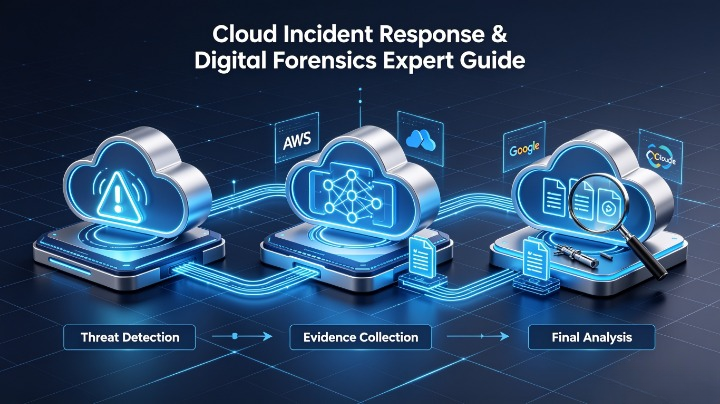
5.3 Step-by-Step Collection Workflow
- Capture volatile evidence first via API/agent
- Take immutable snapshots of all affected disks/volumes
- Export all logs to a secure, offline environment
- Create forensic copies and verify hashes
- Analyze copies only—never originals
5.4 Forensic Analysis Techniques
Timeline Reconstruction
Map events chronologically: login → persistence → lateral movement → exfiltration
Artifact Analysis
- Memory: Detect malware, hidden processes, in-memory exploits
- Disk: Review deleted files, bash history, registry changes, cron jobs
- Cloud Config: Look for backdoors, new roles, modified trust policies
Cross-Cloud Correlation
Link IAM events in AWS with network logs in Azure and storage activity in GCP
5.5 Cloud Forensic Tools
Tabel
| Purpose | Open Source | Enterprise / Native |
|---|---|---|
| Memory Analysis | Volatility 3, Rekall | AWS Inspector, Azure Memory Analyzer |
| Disk/Image | FTK Imager, Autopsy, Sleuth Kit | EnCase, Magnet Forensics |
| Cloud Logs | jq, ELK Stack | Splunk, Azure Sentinel, Google Chronicle |
| Container | Trivy, Dive, Sysdig Inspect | Prisma Cloud, Aqua Security |
6. Attack Reconstruction & Root Cause Analysis
6.1 Map the Full Attack Chain
plaintext
Initial Access → Persistence → Privilege Escalation → Lateral Movement → Data Access → Exfiltration / Impact
6.2 Common Root Causes
- Misconfigured S3/public storage
- Compromised developer credentials/PATs
- Unpatched software vulnerabilities
- Overly permissive IAM roles
- Third-party SaaS/integration breaches
- Insider misuse
6.3 Validate Findings
- Cross-check with threat intelligence (MITRE ATT&CK, Mandiant, Malwarebytes)
- Reproduce the attack in a sandbox environment
- Confirm no additional backdoors or hidden access remain
7. Legal, Regulatory, and Reporting Obligations
- GDPR: Notify regulator within 72 hours; inform affected individuals if high risk
- HIPAA: Notify HHS within 60 days for breaches affecting ≥500 individuals
- PCI-DSS: Notify payment brands immediately; provide full forensic report
- Indonesia PDP Law: Notify Kominfo within 3×24 hours; report affected data subjects
Evidence Retention: Store all forensic data for 5–7 years per most regulations.
8. Real-World Case Study: Ransomware in Multi-Cloud
Background
A healthcare provider using AWS + Azure faced ransomware encryption of patient records. Initial response deleted 17 compromised instances—destroying evidence.
Corrected IR Process
- Deployed cloud IR playbook; isolated affected subnets without deletion
- Captured memory + disk snapshots; preserved all logs
- Reconstructed attack: started from compromised Azure DevOps PAT → AWS role abuse → ransomware deployment
- Provided evidence to regulators; passed HIPAA audit with no extra penalties
- Fixed IAM gaps and enabled immutable logging
Lessons Learned
- Deleting resources is never the first step
- Pre-deployed logging and immutable storage saved the investigation
- Cross-cloud correlation was essential to find the initial entry point
9. Post-Incident Actions & Continuous Improvement
- Remediate: Remove all malware, revoke credentials, rebuild systems from clean images
- Prevent Recurrence: Update policies, fix misconfigurations, add monitoring
- Test: Run quarterly cloud IR simulations (tabletop exercises + red team)
- Update Playbooks: Add lessons learned to your IR guide
10. Common Mistakes & Fixes
❌ Terminating instances immediately → Fix: Isolate network first; snapshot before any change
❌ No immutable logs → Fix: Enable write-only storage with separate admin controls
❌ Manual log collection → Fix: Automate export and hashing to offline SIEM
❌ Ignoring cross-cloud evidence → Fix: Centralize all logs and use cross-cloud correlation
Conclusion
Cloud incident response and forensics require a shift from “clean up fast” to “preserve first, analyze deeply.” By preparing ahead, using cloud-native isolation, following strict evidence rules, and correlating across all environments, you can stop attacks, meet legal requirements, and prevent future breaches. This guide is fully optimized for clouddefense.my.id audiences including security analysts, IR leads, and cloud architects.
References: NIST SP 800-61 Rev. 2, NIST SP 800-86, CSA Cloud Forensics Guidelines, MITRE ATT&CK for Cloud, Mandiant Cloud Threat Report 2026, AWS IR Guide, Azure Forensics Best Practices, GCP Incident Response Playbook.