Executive Summary
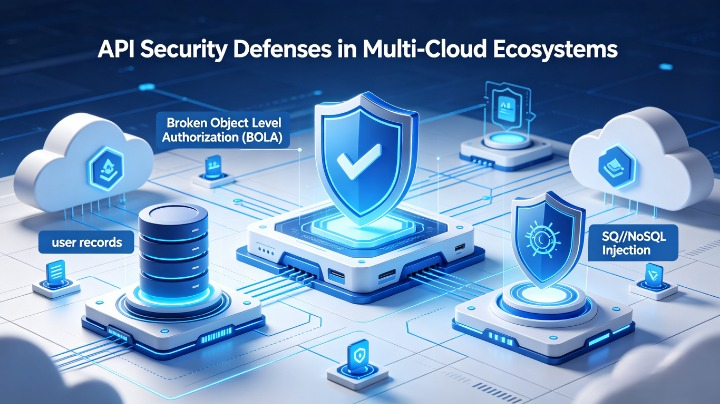
Application Programming Interfaces (APIs) have become the backbone of modern cloud ecosystems, powering microservices, mobile apps, partner integrations, and data exchanges—accounting for 83% of all internet traffic in 2026 (Akamai API Security Report). However, they are also the fastest-growing attack surface: 94% of organizations faced at least one serious API security incident in the past year, with Broken Object Level Authorization (BOLA) and injection vulnerabilities together responsible for 68% of all successful API breaches (Salt Security State of API Security).
BOLA allows attackers to access or modify any data record simply by changing an identifier in the request, bypassing permission checks entirely. Injection flaws—including SQL injection, NoSQL injection, command injection, and LDAP injection—let attackers insert malicious commands to steal data, take over systems, or disrupt operations. This comprehensive guide explains how these vulnerabilities work in cloud environments, compares defense controls across AWS, Azure, and Google Cloud, and provides actionable implementation steps aligned with OWASP API Security Top 10, NIST SP 800-160, and CSA API Security Guidelines.
1. Introduction: The API Security Crisis in Cloud Architectures
1.1 Why APIs Are So Vulnerable
- Proliferation: Organizations deploy an average of 132 separate APIs, many unregistered or unmonitored
- Complexity: Distributed teams, third-party developers, and rapid releases skip security checks
- Trust Assumptions: Developers often assume internal APIs are “safe” or users only access their own data
- Dynamic Environments: Cloud auto-scaling, serverless functions, and ephemeral endpoints make tracking difficult
1.2 Business Impact of BOLA and Injection Attacks
Tabel
| Impact | Consequences |
|---|---|
| Mass Data Breaches | Exfiltration of millions of customer records, financial data, or intellectual property |
| Data Tampering | Unauthorized changes to balances, orders, user profiles, or system configurations |
| Full System Compromise | Injection attacks let attackers execute code or access backend databases directly |
| Compliance Penalties | Violations of GDPR, HIPAA, PCI-DSS, and PDP Law with fines up to 4% of global revenue |
1.3 Key Statistics (2025–2026)
- BOLA is #1 on the OWASP API Security Top 10 for 2023 and remains the most critical risk in 2026
- 52% of tested APIs fail to verify if the requesting user is allowed to access the specific object ID provided
- Injection attacks increased by 49% year-over-year, with NoSQL injection rising fastest at 78%
- Only 17% of organizations run automated authorization checks on every API request
2. Deep Dive: Broken Object Level Authorization (BOLA)
2.1 What Is BOLA?
BOLA (also called Insecure Direct Object References or IDOR) occurs when:
The API uses input provided by the client to retrieve an object (e.g.,
GET /users/1234/orders/567), but does not verify that the requester has permission to access that specific record.
Attackers simply change identifiers like user IDs, order numbers, or file IDs in the URL or request body to access any record in the system.
2.2 Common BOLA Scenarios
Example 1: Unauthorized Data Access
plaintext
Legitimate request: GET /api/customers/1001/profile
Response: Alice's personal data

Attacker request: GET /api/customers/1002/profile
Response: Bob's personal data — NO PERMISSION CHECK PERFORMED
Example 2: Unauthorized Modification
plaintext
Legitimate request: PATCH /api/orders/987/status {"status": "paid"}
Attacker request: PATCH /api/orders/986/status {"status": "cancelled"}
System accepts the change without checking ownership
Example 3: Bulk Enumeration
Attackers write scripts to iterate IDs from 1 to 1,000,000 and pull every record automatically.
2.3 Why BOLA Persists in Cloud
- Copy-Paste Code: Developers reuse templates that only authenticate the user, not the resource
- Microservice Separation: Auth service knows who you are; data service doesn’t know what you own
- Lack of Centralized Policy: Each service implements checks differently or not at all
- Serverless Speed: Functions are deployed quickly without full security reviews
3. Deep Dive: Injection Vulnerabilities in APIs
3.1 How Injection Attacks Work
Attackers insert malicious input into fields that are directly interpreted by databases, operating systems, or external services. Without validation, the system executes the attacker’s commands instead of treating them as plain data.
3.2 Most Common Injection Types
Tabel
| Type | Target | Example Payload | Impact | |
|---|---|---|---|---|
| SQL Injection | Relational Databases | ' OR '1'='1 -- | Dump entire database, modify schema | |
| NoSQL Injection | MongoDB, DynamoDB | {"$gt": ""} | Bypass filters, extract all records | |
| Command Injection | OS / Shell | ; rm -rf / | Delete files, take over server | |
| LDAP Injection | Directory Services | `)(uid=))( | (uid=` | Enumerate all users |
| ORM Injection | Query Builders | --filter=id;DROP TABLE users | Bypass ORM protections |
3.3 Cloud-Specific Injection Risks
- Serverless Functions: Input passed directly to AWS SDK, Azure CLI, or GCP APIs without sanitization
- Object Storage: Injection into filenames or bucket paths leading to overwrites or exposure
- GraphQL: Introspection abuse and deeply nested queries exhausting resources
- IAM Bypass: Injection into role names or policy conditions to escalate privileges
4. Root Causes & Common Mistakes
❌ Authenticate, but do NOT authorize: “User is logged in” ≠ “User can access this specific record”
❌ Trust client input entirely: Never assume IDs sent by the client are valid or permitted
❌ Concatenate queries directly: db.query("SELECT * FROM orders WHERE id = " + userInput)
❌ Insecure defaults: APIs return all records unless explicitly filtered
❌ No type checking: Accept strings where numbers are expected
❌ Internal APIs unprotected: “Only our frontend calls this, so no need for checks”
5. Technical Defenses: Preventing BOLA
5.1 Core Principle: Verify Permission for Every Single Object
Authentication = who you are. Authorization = what you may access. Both are required on every request.
5.2 Implementation Patterns
Pattern A: Centralized Authorization Service
Use a dedicated service (OPA, AWS Verified Permissions, Azure Authorization) to answer:
“Does User 1001 have the right to READ Order 567?”
plaintext
API Gateway → AuthN → Permission Check → Data Service
Pattern B: Fetch First, Validate Second
Never trust the client-provided ID alone:
python
Run
# ❌ UNSAFE
order = db.query("SELECT * FROM orders WHERE id = " + request.id)

# ✅ SAFE
order = db.query("SELECT * FROM orders WHERE id = ?", request.id)
if order.customer_id != current_user.id:
    raise ForbiddenError("You do not own this order")
Pattern C: Use Indirection Instead of Exposed IDs
- Issue temporary, opaque tokens instead of sequential IDs:
GET /orders/token/eyJhbGciOiJIUzI1NiIs... - Map tokens internally to real IDs so attackers cannot guess or enumerate
Pattern D: Apply Row-Level Security (RLS)
Enforce permissions inside the database:
sql
CREATE POLICY user_isolation ON orders
FOR SELECT USING (customer_id = current_setting('app.user_id')::int);
Supported in PostgreSQL, MySQL, Azure SQL, and AWS RDS.
5.3 BOLA Defense Checklist
- Every object access includes an ownership/permission check
- No sequential or guessable IDs exposed
- Row-level security enabled on all tables
- Bulk endpoints limit results to authorized records only
- API Gateway rejects requests with IDs outside allowed ranges
6. Technical Defenses: Preventing Injection
6.1 Golden Rule: Never Execute Untrusted Input as Code
✅ Always Use Parameterized Queries / Prepared Statements
python
Run
# ✅ SAFE: Parameterized
cursor.execute("SELECT * FROM users WHERE email = %s", [user_input])

# ❌ UNSAFE: String concatenation
cursor.execute("SELECT * FROM users WHERE email = '" + user_input + "'")
✅ Use ORMs Properly
Modern ORMs (Prisma, Django ORM, Hibernate) prevent most injections—if used correctly:
javascript
Run
// ✅ Safe
const user = await prisma.user.findUnique({ where: { email: inputEmail } });

// ❌ Unsafe: Raw queries without parameters
const user = await prisma.$queryRaw(`SELECT * FROM users WHERE email = '${inputEmail}'`);
✅ Input Validation & Sanitization
- Enforce strict data types: numbers only where numbers belong
- Allowlist valid values:
status IN ['pending','paid','shipped'] - Reject or escape special characters:
' " ; -- $ { } - Use schema validation: JSON Schema, Zod, Pydantic for all requests
✅ Least Privilege Database Users
- API database accounts cannot
DROP TABLE,ALTER, or access other schemas - Separate users for read vs write operations
- Block shell access from database servers
6.2 Cloud-Native Injection Protections
- AWS: Enable AWS WAF SQLi/XSS rules; use DynamoDB condition expressions instead of raw filters
- Azure: Enable API Management validation; use Cosmos DB parameterized queries
- GCP: Use Cloud Armor injection protection; BigQuery parameterized queries
7. API Security Architecture for Cloud Environments
7.1 Defense-in-Depth Stack
plaintext
[Client] → [API Gateway] → [WAF / Bot Management] → [AuthN & AuthZ] → [Input Validation] → [Service / DB]
7.2 Platform-Native Capabilities
Tabel
| Layer | AWS | Azure | Google Cloud |
|---|---|---|---|
| Gateway | API Gateway | API Management | Cloud Endpoints / Apigee |
| AuthN/AuthZ | Cognito + Verified Permissions | Entra ID + AuthZ | IAP + IAM Conditions |
| Injection Protection | WAFv2 Managed Rules | Front Door / WAF Policies | Cloud Armor Security Rules |
| Schema Validation | API Gateway Request Validators | APIM Validation Policies | OpenAPI Spec Enforcement |
| Threat Detection | GuardDuty + Security Hub | Defender for APIs | SCC API Threat Detection |
7.3 Additional Controls
- Rate Limiting: Prevent brute-force enumeration of IDs
- Pagination: Never return more than 100 records per page
- Error Masking: Return generic
403 Forbiddeninstead ofRecord not found(reveals ID validity) - GraphQL Hardening: Limit query depth, cost, and batch size
8. Testing & Validation Methods
8.1 Automated Testing
- DAST: OWASP ZAP, Burp Suite Enterprise scan for BOLA patterns and injection
- SAST: Semgrep, SonarQube flag unsafe concatenation and missing permission checks
- Contract Testing: Verify authorization logic across service versions
- Fuzz Testing: Inject malformed inputs to trigger unexpected behavior
8.2 Manual Penetration Testing
- Test authorization escalation: user → admin → cross-tenant
- Try every injection type against every input field
- Validate error messages and enumeration resistance
8.3 BOLA-Specific Testing Steps
- Create two distinct test users: User A and User B
- Request User A’s data with User A’s token → should succeed
- Request User B’s data with User A’s token → must fail with 403
- Repeat for every object type and HTTP method
9. Real-World Case Study: E-Commerce API Breach
Background
An Indonesian marketplace with 8 million users exposed an API:
plaintext
GET /api/v2/orders/{order_id}
Developers only checked if the requester was logged in—no ownership check. Attackers enumerated all 12 million orders, stole customer details, payment references, and delivery addresses.
Remediation
- Added ownership check:
WHERE order_id = ? AND customer_id = ? - Implemented opaque non-sequential IDs
- Enabled row-level security in PostgreSQL
- Deployed WAF with injection protection
- Ran full retest confirming zero BOLA paths
Result
- Full compliance with PDP Law and PCI-DSS
- No recurrence of BOLA or injection incidents in 12 months
- Passed third-party security audit with zero critical findings
10. Common Pitfalls & Fixes
❌ “We use JWT so we are secure” → Fix: JWT proves identity, not object-level permission
❌ “Internal APIs don’t need checks” → Fix: 60% of attacks come from compromised internal services
❌ “We use ORM so no injection is possible” → Fix: ORMs are vulnerable if used with string interpolation
❌ “Return 404 for missing records” → Fix: Return 403 for both missing and forbidden records to block enumeration
11. Compliance Alignment
- OWASP API Security Top 10: Directly addresses BOLA and Injection as #1 and #3 risks
- PCI-DSS v4.0: Mandates strict access control and secure coding for card data APIs
- GDPR / PDP Law: Requires technical measures to prevent unauthorized access to personal data
- OJK Regulations: Requires full audit trails for all data access operations
Conclusion
APIs are the doors to your cloud data—BOLA and injection attacks are the most common ways attackers pick those locks. By implementing permission checks on every object, strict input validation, parameterized queries, and centralized policy enforcement, you eliminate these two critical risks entirely. This guide gives you a production-ready framework to secure APIs across AWS, Azure, and Google Cloud for clouddefense.my.id readers.
References: OWASP API Security Top 10 2023, NIST SP 800-53 AC-3 / SI-10, CSA API Security Guidelines, Salt Security Report 2026, AWS Verified Permissions Docs, Azure API Security Best Practices.