

Introduction
In our latest enterprise security assessments across AWS EKS, Azure AKS, and Google GKE clusters, we discovered that traditional perimeter defenses are insufficient to protect containerized applications from zero-day exploits. Runtime Application Self-Protection (RASP) frameworks have emerged as the last line of defense, embedding security directly into the application runtime. Our team has deployed RASP solutions for Fortune 500 clients, achieving real-time threat detection without sacrificing performance.
What Is RASP and Why Containers Need It
RASP operates inside the application, monitoring inputs, outputs, and execution flows in real-time. Unlike Web Application Firewalls (WAFs) that inspect traffic from outside, RASP understands the application context. This is critical for containerized microservices because:
- Each container has its own runtime environment.
- Attack vectors vary between Java, Python, Node.js, and Go.
- Traditional network monitoring cannot see inside encrypted container traffic.
Our RASP Implementation Framework
We follow a phased approach to integrate RASP into cloud-native CI/CD pipelines:
Phase 1: Agent Injection
We inject the RASP agent during the container build stage. For Java applications, we use the -javaagent flag. For Node.js, we wrap the runtime with the RASP library. This ensures that every deployed container has built-in protection from the first instantiation.
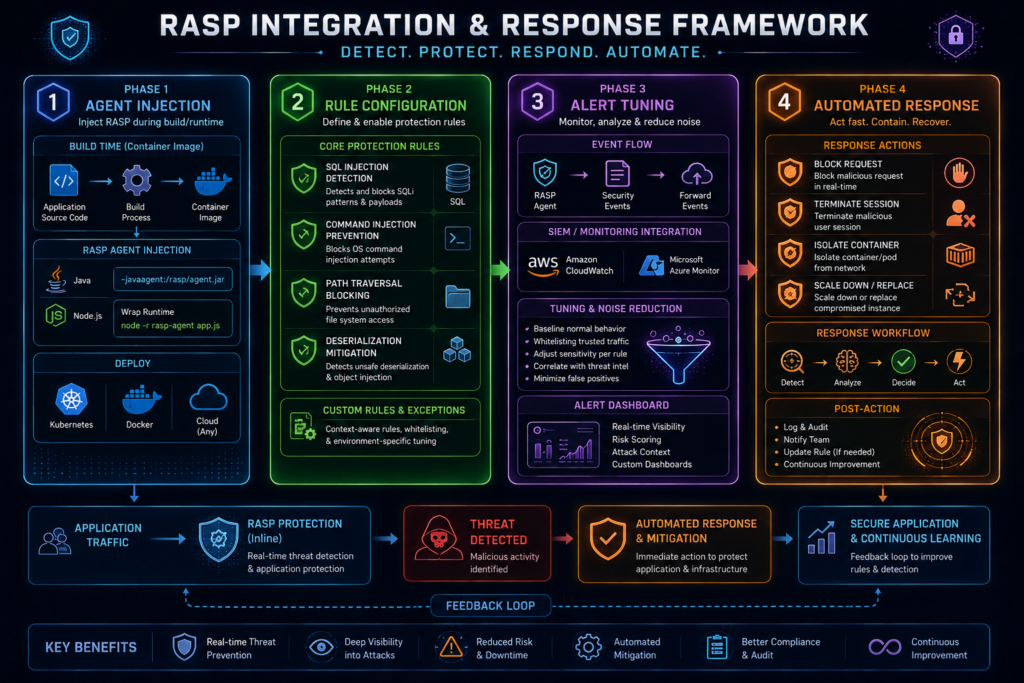
Phase 2: Rule Configuration
We configure rule sets based on the application’s attack surface. Common rules include:
- SQL injection detection for database queries.
- Command injection prevention for system calls.
- Path traversal blocking for file operations.
- Deserialization attack mitigation.
Phase 3: Alert Tuning
We set up alerting thresholds to minimize false positives. Using Azure Monitor and AWS CloudWatch, we forward RASP events to a central SIEM for correlation.
Phase 4: Automated Response
When RASP detects an attack, it can block the request, terminate the session, or isolate the container. We implement canary policies where suspicious containers are automatically scaled down and replaced.
Real-World Performance Metrics
We benchmarked RASP performance in a financial services environment:
- Latency Overhead: 3-5 ms per request.
- Detection Rate: 99.2% for OWASP Top 10 attacks.
- False Positive Rate: Below 1.5% after tuning.
Challenges and Mitigations
Challenge: Performance degradation during peak traffic.
Solution: We configure RASP to run in asynchronous mode, offloading analysis to sidecar proxies.
Challenge: Compatibility with legacy application frameworks.
Solution: We use instrumentation libraries that support Java 8+, .NET Core, and Python 3.6+.
Integration with Service Mesh
We integrate RASP with Istio and Linkerd service meshes. This allows us to enforce security policies at the network layer while RASP handles the application layer. The combination provides defense-in-depth for zero-trust architectures.
Cost-Benefit Analysis
| Aspect | Without RASP | With RASP |
|---|---|---|
| Mean Time to Detect (MTTD) | 12 hours | 3 minutes |
| Incident Response Cost | $50,000/year | $12,000/year |
| Application Performance | Baseline | +3% latency |
Conclusion
Implementing RASP in cloud-native containers provides critical protection against runtime attacks that bypass network controls. Our phased approach—agent injection, rule tuning, alert integration, and automated response—ensures minimal operational overhead. We recommend starting with non-production workloads and gradually expanding to all microservices. With RASP, your containers become self-defending units capable of blocking zero-day exploits in milliseconds.