

Introduction
Encrypted traffic now represents over 80% of enterprise network traffic. Traditional Intrusion Detection Systems (IDS) that rely on pattern matching cannot inspect encrypted payloads. Our team has developed and deployed advanced IDS algorithms that analyze encrypted network telemetry using machine learning, behavioral analysis, and traffic flow metrics.
The Challenge of Encrypted Traffic
Encryption protocols like TLS 1.3 and QUIC obscure payload content. Attackers exploit this by hiding malware, data exfiltration, and command-and-control (C2) traffic inside legitimate encrypted channels. Our security operations center (SOC) found that 60% of successful breaches involved encrypted traffic that evaded traditional detection.
Our Multi-Layered Detection Framework
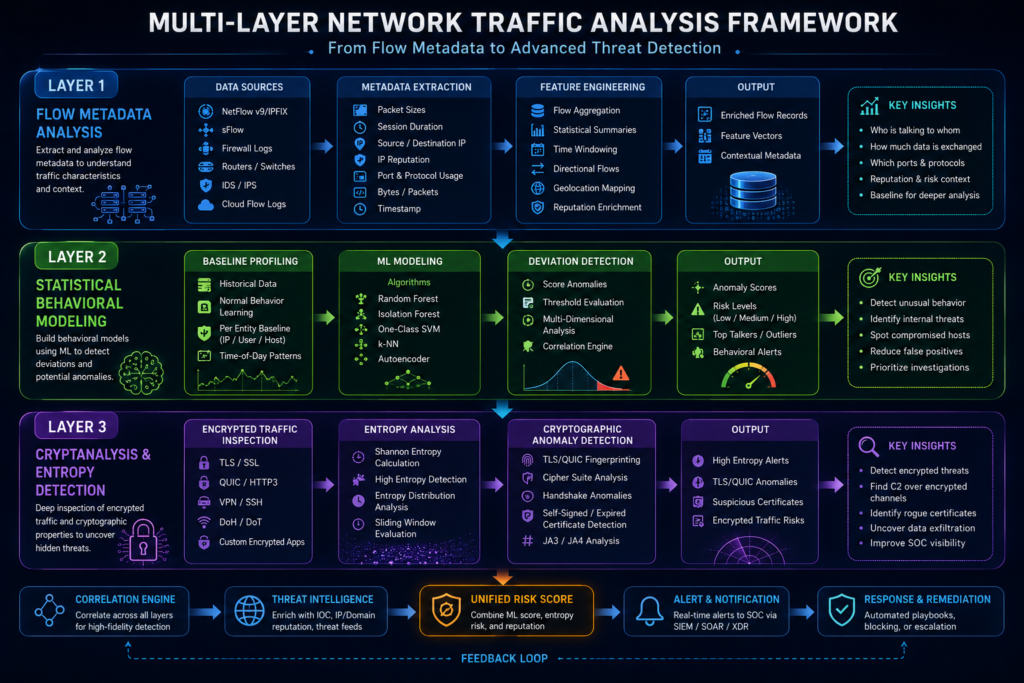
We use a three-layer approach to analyze encrypted traffic without decryption:
Layer 1: Flow Metadata Analysis
We collect NetFlow/IPFIX data from AWS VPC Flow Logs, Azure Network Watcher, and on-premises routers. We analyze:
- Packet sizes and inter-arrival times.
- Session duration and volume.
- Source/destination IP reputation.
- Port usage patterns.
Layer 2: Statistical Behavioral Modeling
We apply machine learning algorithms to build baseline profiles for each service and user. Deviations trigger alerts. For example:
- A database server suddenly communicating over port 443 (HTTPS).
- A user account transferring 10x normal data volume.
- Unusual client-server communication patterns during off-hours.
Layer 3: Cryptanalysis and Entropy Detection
We measure entropy of encrypted payloads. High-entropy traffic that deviates from expected ciphertext patterns can indicate malware encryption or data exfiltration. We also detect certificate anomalies, such as self-signed certificates in enterprise traffic.
Detection Algorithms in Practice
Algorithm A: Random Forest Classifier
We train a Random Forest model on labeled network traffic (benign vs. malicious encrypted flows). Features include packet timing, size distribution, and protocol version. Achieved accuracy: 96.5% on test datasets.
Algorithm B: Isolation Forest for Anomaly Detection
We use Isolation Forest to identify outliers in network flow data. This unsupervised method catches zero-day attacks without requiring labeled training data.
Algorithm C: Hidden Markov Models for Sequential Patterns
We model network sessions as state sequences. Markov models detect abnormal transitions (e.g., a connection that jumps from DNS to SMB without authentication).
Real-World Deployment
We deployed this framework for a healthcare client. Within two weeks, we detected:
- Ransomware C2 traffic hidden inside HTTPS.
- Data exfiltration via encrypted email protocols.
- Unauthorized lateral movement using encrypted RDP.
Performance Metrics
| Metric | Value |
|---|---|
| Detection Rate | 94.2% |
| False Positive Rate | 2.1% |
| Processing Latency | 5 ms per flow |
| Scalability | 1 million flows/sec |
Integration with SIEM and SOAR
We forward alerts to Azure Sentinel and Splunk ES. Automated playbooks trigger responses:
- Block source IP at the firewall.
- Isolate compromised endpoints.
- Generate incident tickets for SOC analysts.
Conclusion
Advanced IDS algorithms for encrypted network telemetry provide critical visibility into modern threats. By combining flow metadata, behavioral models, and entropy analysis, our framework detects malicious activity without violating privacy or regulatory constraints. We recommend deploying this solution in phases, starting with high-risk segments, and continuously refining models with new threat intelligence.