Abstract
As global enterprises accelerate large-scale migration to multi-cloud, hybrid, and geographically distributed infrastructure, the traditional perimeter-centric security model has become entirely obsolete. Modern organizations operate across dozens of sovereign regions, collaborate with thousands of third-party vendors and partners, and serve millions of end-users via diverse devices, networks, and access channels — creating an ever-expanding and highly dynamic attack surface. Isolated defensive measures are no longer sufficient to counter today’s sophisticated threats, including state-sponsored cyberattacks, targeted ransomware campaigns, supply chain compromises, mass data exfiltration, and configuration-driven breaches.
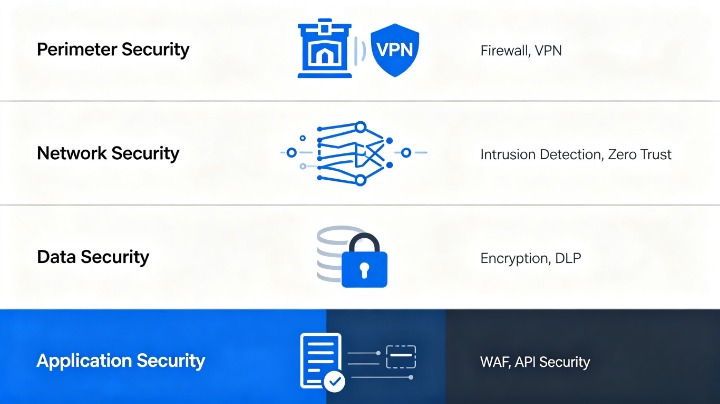
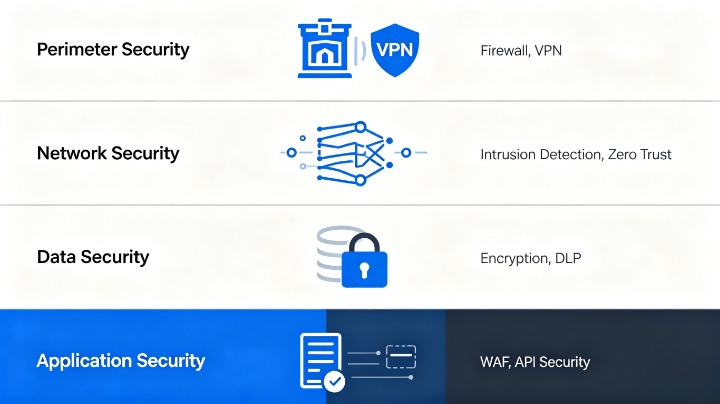
This comprehensive guide outlines how to design, implement, and operate a multi-layered defense-in-depth architecture aligned with the core principles of Zero Trust. It covers every critical component, cross-cloud and cross-border implementation considerations, compliance alignment frameworks, operational roadmaps, and measurable success metrics specifically tailored for large global corporations. The article also includes detailed comparison tables, actionable control matrices, and real-world implementation insights to help security leaders build resilient, scalable, and future-proof cloud security postures.
1. Introduction: The New Reality of Enterprise Cloud Security
1.1 Why Traditional Perimeter Defense Has Failed
For over three decades, enterprise security relied on the “castle-and-moat” paradigm: deploy strong firewalls at the network edge, apply basic filtering rules, and grant implicit trust to any user or system located “inside” the corporate network. This model worked effectively when most workloads ran in on-premises data centers, employees accessed resources exclusively from fixed office locations, and external connections were limited and tightly controlled.
Today, however, this approach has completely broken down for four key reasons:
- The disappearing perimeter: Workloads now run across AWS, Azure, Google Cloud, local regional clouds, and legacy on-premises systems; employees work from home, remote branches, or international locations; third-party partners and contractors connect directly to core business systems; and IoT/OT devices operate outside traditional network boundaries. There is no longer a clear line between “internal” and “external.”
- Unprecedented complexity: Multi-cloud deployments, microservices architectures, containers, serverless functions, and ephemeral resources create millions of unique configuration combinations and potential access points. According to Wiz’s 2026 Global Cloud Security Report, the average enterprise multi-cloud environment contains 2.7 million misconfiguration risks at any given time.
- Evolving threat tactics: Attackers now combine social engineering, credential stuffing, automated vulnerability scanning, zero-day exploits, and lateral movement techniques to bypass single-layer defenses. Verizon’s 2026 Data Breach Investigations Report confirms that 74% of all cloud breaches stem from basic human error or misconfiguration — gaps that single tools can rarely catch.
- Fragmented global compliance: Organizations must simultaneously comply with conflicting data protection, privacy, and sovereignty laws across jurisdictions — including the EU GDPR, China’s PIPL, Brazil’s LGPD, Indonesia’s PDP Law, and India’s DPDP Act. Non-compliance can result in fines of up to 4% of global annual revenue, plus operational restrictions in entire markets.
1.2 Core Concept: Multi-Layered Defense + Zero Trust
Multi-layered security — formally called defense-in-depth — means deploying independent, complementary security controls at every possible point of interaction. If one layer is bypassed, disabled, or compromised, subsequent layers will block, delay, or contain the threat before it reaches critical assets.
When combined with Zero Trust — the foundational philosophy of “never trust, always verify, assume breach” — this architecture eliminates all implicit trust. Every access request, regardless of origin, is authenticated, authorized, and continuously validated based on real-time context, not just network location.
For global corporations, this architecture must deliver three non-negotiable outcomes:
- Minimize blast radius: Even if an attacker gains initial access, they cannot move laterally or access sensitive data.
- Consistent protection: Apply uniform security policies across all clouds, regions, and environments without gaps or exceptions.
- Sustainable scalability: Add new business units, regions, cloud services, or partners without rebuilding the entire security framework.
2. Guiding Frameworks and Foundational Principles
2.1 Industry Standards and Compliance Frameworks
Global enterprises should anchor their architecture on established standards to ensure consistency, auditability, and regulatory alignment:
Table
| Framework / Standard | Primary Purpose | Key Coverage Areas | Best Use Case |
|---|---|---|---|
| NIST SP 800-207 (Zero Trust Architecture) | Official engineering blueprint for Zero Trust | Identity verification, least privilege, microsegmentation, continuous trust assessment | All organizations, especially multi-cloud deployments |
| NIST Cybersecurity Framework (CSF) | Enterprise-wide risk management | Identify, Protect, Detect, Respond, Recover | Align security with business risk priorities |
| ISO/IEC 27001 / 27017 / 27018 | International information security and cloud standards | ISMS requirements, cloud-specific controls, PII protection | Global certification, cross-border compliance |
| CSA Cloud Controls Matrix (CCM) | Cloud-specific control mapping | IAM, infrastructure security, data protection, supply chain, compliance | Multi-cloud governance, audit preparation |
| CIS Benchmarks | Secure configuration baselines | Cloud services, OS, containers, network devices | Reduce misconfiguration risks by up to 90% |
| PCI DSS 4.0 / HIPAA / LGPD / PDP Law | Industry and region-specific mandates | Payment data, health records, local data sovereignty | Regulated industries and country-specific operations |
Sources: NIST, ISO, Cloud Security Alliance, Center for Internet Security, 2026
2.2 Deep Dive: The Shared Responsibility Model
One of the most common causes of cloud security failures is misunderstanding who is responsible for what between the enterprise and cloud service providers (CSPs):
Table
| Service Model | CSP Responsibility | Enterprise Responsibility | Common Gaps & Mistakes |
|---|---|---|---|
| IaaS (AWS EC2, Azure VMs, GCP Compute Engine) | Physical infrastructure, hypervisor, network hardware, facility security | Guest OS hardening, patching, applications, data, IAM policies, network configuration | Failing to apply OS security patches, leaving ports open, overgranting VM permissions |
| PaaS (AWS ECS, Azure SQL, GCP GKE) | Platform runtime, database engine, underlying infrastructure, patching platform components | Application logic, data classification, access policies, encryption keys, service configuration | Using default access rules, disabling logging, not rotating customer-managed keys |
| SaaS (Microsoft 365, Salesforce, Workday) | Full platform availability, core security, infrastructure patching | User lifecycle management, data sharing rules, content classification, compliance alignment | Sharing sensitive files publicly, not revoking former employee accounts, missing DLP rules |
Sources: AWS, Azure, Google Cloud Shared Responsibility Documentation, 2026
2.3 Core Design Principles for Global Deployment
- Identity is the new perimeter: Shift focus from static IP addresses to verified identities and real-time context — IP addresses can be spoofed or shared, but verified identity cannot.
- Deny by default, least privilege: Start with zero access permissions; grant only the exact minimum access required to perform a specific task, for the shortest necessary duration.
- Defense at every tier: Protect the edge, network, platform, application, data, and management planes independently — so a failure in one layer does not cascade to others.
- Global policy, local enforcement: Define security rules centrally, but adapt implementation to meet regional legal requirements and cloud provider capabilities.
- Continuous verification: Trust is temporary — re-evaluate access on every single request, based on device health, user behavior, location, and data sensitivity.
- Assume breach: Design systems to detect, contain, and recover from incidents rapidly, rather than focusing exclusively on preventing entry.
3. Seven Layers of Multi-Layered Cloud Security Architecture
Below is the complete defense stack, organized from external entry points inward to core business assets.
Layer 1: Edge and External Threat Protection
This is the first line of defense — it blocks malicious traffic and attacks before they ever touch enterprise infrastructure.
- Global DDoS protection: Deploy always-on volumetric, protocol, and application-layer DDoS scrubbing across all regions to absorb traffic surges and prevent service outages. Use anycast routing to distribute attack load across global data centers.
- Web Application Firewall (WAF): Deploy WAF at the CDN or load balancer level to block OWASP Top 10 threats — including SQL injection, cross-site scripting (XSS), command injection, and API abuse. Enable custom rule sets, geo-blocking, and rate limiting to stop targeted attacks.
- Secure CDN and edge computing: Isolate origin servers from direct public access; cache static content at edge locations closer to users to reduce attack surface and improve performance. Run lightweight threat inspection at the edge to filter malicious requests early.
- DNS and domain security: Implement DNSSEC to prevent DNS hijacking and spoofing; filter access to known malicious domains via DNS firewalls; enforce strict domain registrar controls to prevent unauthorized domain transfers.
Global Consideration: Ensure edge services comply with local data localization laws — for example, do not route traffic from regulated regions through unapproved jurisdictions.
Layer 2: Network Security and Segmentation
Once traffic passes the edge, network controls prevent unauthorized access and stop lateral movement — the single most effective way to limit breach damage.
- Global transit architecture: Use a hub-and-spoke topology with centralized inspection via AWS Transit Gateway, Azure Virtual WAN, or GCP Cloud Router. Avoid direct peering between production VPCs/VNets to prevent uninspected traffic flows.
- Zero Trust segmentation:
- Macro-segmentation: Create isolated zones for production, staging, development, and sandbox environments; separate business units and compliance domains (e.g., PCI, HIPAA) with no default routing between zones.
- Micro-segmentation: Enforce granular per-workload rules using security groups, network policies, or service meshes. For example, application servers can only communicate with specific database ports, and databases cannot initiate outbound connections to the internet.
- No public exposure: Use AWS PrivateLink, Azure Private Endpoints, or GCP Private Service Access to keep cloud APIs, databases, and internal services entirely off the public internet.
- Full encryption: Enforce IPsec/GRE encryption for all cross-region traffic; mandate TLS 1.3 for all internal and external communications; disable legacy protocols like HTTP, FTP, and unencrypted SMTP entirely.
- Third-party access: Use dedicated private connections (AWS Direct Connect, Azure ExpressRoute) or Zero Trust Network Access (ZTNA) portals for partners — never grant full VPN access to external parties.
Multi-Cloud Capability Comparison:
Table
| Capability | AWS | Azure | Google Cloud |
|---|---|---|---|
| Global inter-region connectivity | Transit Gateway + Cloud WAN | Virtual WAN + Secure Hub | Shared VPC + Cross-Cloud Interconnect |
| Micro-segmentation controls | Security Groups + Network ACLs + Network Firewall | NSGs + ASGs + Azure Firewall Premium | Hierarchical Firewall + Service Account Targets |
| Private service access | VPC Endpoints + PrivateLink | Private Endpoints + Private Link | VPC Service Controls + Private Access |
| Deep traffic inspection | Gateway Load Balancer + NVA integration | Firewall Premium + IDPS | Cloud Firewall + IDS |
Sources: Cloud Provider Well-Architected Frameworks, 2026
Layer 3: Identity and Access Management (IAM)
IAM is the foundation of Zero Trust — compromised or mismanaged credentials cause 47% of cloud breaches, per CrowdStrike’s 2026 Global Threat Report.
- Unified identity plane: Deploy a single global Identity Provider (IdP) such as Entra ID, Okta, or Ping Identity to manage all human users, service accounts, and machine identities across all clouds. Use SAML 2.0/OIDC for federation with local directories.
- Strong authentication everywhere:
- Mandatory phish-resistant MFA (FIDO2 security keys, passkeys) for every user, especially administrators — block SMS, email, and app-only MFA entirely.
- Certificate-based authentication for servers, containers, APIs, and IoT devices to ensure only trusted systems can connect.
- Least privilege enforcement:
- Role-Based Access Control (RBAC): Align permissions strictly to job functions, not project needs — avoid broad “editor” or “owner” roles.
- Attribute-Based Access Control (ABAC): Use dynamic rules to grant access only under specific conditions — e.g., “finance teams can access payment data only from managed corporate devices during approved business hours.”
- Just-in-Time (JIT) access: Grant temporary admin privileges with pre-defined expiry and mandatory approval — never assign permanent admin rights.
- Machine identity hygiene: Eliminate long-term access keys; use instance profiles, managed identities, or short-lived tokens only; store secrets in centralized vaults with automatic rotation.
- Regular access reviews: Audit permissions quarterly to remove inactive users, stale cross-account trusts, and overprivileged roles.
Global Consideration: Ensure your IdP complies with local identity regulations — for example, supporting local national ID verification in jurisdictions that require it.
Layer 4: Workload and Platform Security
This layer protects the actual systems running your business — workloads, containers, serverless functions, and PaaS services.
- Secure provisioning: Use CIS-hardened, signed golden images for VMs; scan all templates for vulnerabilities before deployment; block unapproved community images from public marketplaces.
- Kubernetes and container security:
- Disable public cluster endpoints; enable private nodes and full audit logging.
- Enforce Pod Security Standards to block privileged containers, root access, and insecure host mounts.
- Scan all container images for vulnerabilities, malware, and SBOM compliance before deployment; block non-compliant images automatically.
- Serverless and PaaS hardening: Restrict function execution permissions to the minimum required; scan Infrastructure-as-Code (IaC) templates for risky configurations before deployment; disable unused service features.
- Vulnerability management: Automatically scan OS, libraries, and dependencies; patch critical vulnerabilities within 72 hours; isolate unpatched assets automatically until remediated.
- Runtime threat detection: Deploy Cloud Workload Protection (CWP) tools to detect reverse shells, credential dumping, unusual process spawning, and outbound connections to known malicious IPs.
Layer 5: Data Protection
The ultimate goal of all defense is protecting your data — this layer safeguards information across its entire lifecycle.
- Standardized data classification: Tag all assets into four tiers: Public → Internal → Confidential → Restricted (PII, payment, intellectual property). Apply all security controls based strictly on classification level.
- Encryption everywhere:
- In transit: Enforce TLS 1.3 for all communications; reject connections using TLS 1.2 or older.
- At rest: Enable default encryption for all storage, databases, and backups; use Customer-Managed Keys (CMKs/CMEKs) for Confidential and Restricted data — never rely on default provider-managed keys for sensitive assets.
- In use: Deploy confidential computing and secure enclaves for highly regulated workloads like financial transactions or healthcare data processing.
- Centralized key management: Use a dedicated KMS with strict access controls; use separate keys for each data classification tier; store master key backups offline in geographically secure locations.
- Data Loss Prevention (DLP): Scan all traffic, storage, and endpoints for unauthorized transfers of sensitive patterns; block exfiltration to unapproved regions, consumer tools, or external domains.
- Data sovereignty enforcement: Store Restricted data only in pre-approved regions per local law; disable cross-region replication for regulated data without explicit legal and compliance approval.
Layer 6: Observability, Detection, and Response
Even with perfect prevention, you must detect and neutralize incidents rapidly — the average attacker stays undetected for 277 days in cloud environments (IBM 2026 Cost of a Data Breach Report).
- Unified logging and SIEM: Aggregate logs from all clouds, networks, IAM, applications, and endpoints into a centralized SIEM; standardize fields using CloudEvents or OpenTelemetry for cross-source correlation. Retain immutable logs for 12–24 months per regulatory requirements.
- Continuous posture management: Use Cloud Security Posture Management (CSPM) tools to continuously compare configurations against benchmarks; auto-remediate risks like public buckets, overly permissive IAM rules, or disabled encryption.
- Threat intelligence and anomaly detection: Integrate global and regional threat feeds to detect known malicious indicators; use AI/ML to flag anomalies such as unusual login locations, bulk data exports, or sudden admin account creation.
- Automated incident response:
- Build pre-configured SOAR playbooks for common incidents: auto-isolate compromised workloads, revoke credentials, block IPs, and notify the relevant team within minutes.
- Align playbooks with local legal requirements — for example, mandatory breach notification timelines and data retention rules.
- Forensics readiness: Maintain immutable backups and snapshots stored separately from production; preserve forensic evidence without altering original systems.
Layer 7: Governance, Compliance, and Supply Chain
This top layer ensures your architecture remains effective, compliant, and secure as your business evolves.
- Policy-as-Code: Enforce guardrails at the organization/management group level — block creation of public storage, disable unapproved services, and enforce mandatory tagging before any resource can be deployed.
- Multi-cloud governance: Use Cloud Security Mesh Architecture (CSMA) to apply consistent policies across all cloud providers without rewriting rules for each platform.
- Supply chain security: Scan third-party code and open-source dependencies; require full SBOMs for all commercial software; audit vendor security practices annually and include security clauses in all contracts.
- Audit and reporting: Generate standardized reports for global frameworks and region-specific regulations; maintain immutable audit trails for required periods.
- Continuous validation: Conduct quarterly threat modeling for critical systems; run annual penetration testing and red team exercises to identify gaps that automated tools cannot detect.
4. Implementation Roadmap for Global Corporations
Building this architecture typically takes 12–24 months, depending on your current cloud maturity:
Table
| Phase | Timeline | Primary Focus | Key Deliverables |
|---|---|---|---|
| 1. Foundation & Assessment | Months 1–3 | Align strategy and baseline | Enterprise risk assessment, framework selection, shared responsibility matrix, unified data classification standard |
| 2. Identity & Network Baseline | Months 4–7 | Zero Trust core setup | Unified IdP deployment, global MFA rollout, hub-and-spoke topology, macro-segmentation, default encryption |
| 3. Workload & Data Hardening | Months 8–12 | Protect core assets | Micro-segmentation rules, container security, DLP implementation, CMK rollout, data localization controls |
| 4. Detection & Response | Months 13–18 | Visibility and automation | Unified SIEM, CSPM integration, auto-remediation workflows, global incident playbooks |
| 5. Governance & Optimization | Months 19–24 | Scale and mature | Policy-as-Code guardrails, CSMA deployment, continuous compliance dashboards, regular red teaming |
Critical Success Factors:
- Secure executive sponsorship and cross-region alignment from day one.
- Start with high-risk business units (finance, customer data) before expanding enterprise-wide.
- Integrate security directly into CI/CD pipelines — do not treat it as a post-deployment step.
- Train teams on cloud-native security; legacy on-premises tools rarely work effectively in multi-cloud environments.
5. Key Global Challenges and Mitigations
5.1 Multi-Cloud Inconsistency
Challenge: Different clouds use incompatible APIs, terminology, and security primitives, leading to policy gaps and duplicated work.
Mitigation: Define control objectives rather than provider-specific features; use CSMA/SASE to abstract provider differences; use reusable IaC modules that auto-convert policies for each cloud.
5.2 Regional Data Sovereignty Laws
Challenge: Many jurisdictions require data and logs to stay within national borders, while others restrict cross-border access for auditing.
Mitigation: Design geographically isolated data zones; store encryption keys in the same jurisdiction as the data they protect; maintain separate audit copies for restricted regions.
5.3 Latency vs. Centralized Security
Challenge: Centralized inspection in one region slows access for users on other continents.
Mitigation: Deploy inspection points in every major business region; use edge security for latency-sensitive workloads; centralize only long-term logging and threat correlation.
5.4 Third-Party Access Risks
Challenge: Global enterprises work with thousands of vendors, creating unmonitored access points.
Mitigation: Ban direct network access for partners — use ZTNA or API gateways only; grant time-bound least-privilege access; audit partner activity monthly.
6. Effectiveness Metrics and KPIs
Track these indicators to validate your security posture:
Table
| Metric | Target | What It Measures |
|---|---|---|
| Unencrypted resources | 0% | Encryption enforcement success |
| Overprivileged accounts | <5% | Least privilege implementation |
| Critical vulnerability remediation | <72 hours | Risk exposure window |
| Policy compliance rate | >98% | Guardrail effectiveness |
| Mean Time to Detect (MTTD) | <4 hours | Threat visibility speed |
| Mean Time to Respond (MTTR) | <8 hours | Incident handling efficiency |
| Blocked lateral movement attempts | >99% | Segmentation strength |
7. Conclusion
For global corporations, cloud security is no longer a technical afterthought — it is a critical business enabler that protects brand reputation, ensures market access, and preserves customer trust. A multi-layered Zero Trust architecture moves beyond “building higher walls” to creating a resilient system where no single failure compromises the entire enterprise.
By systematically strengthening defenses across the edge, network, identity, workload, data, observability, and governance layers — while aligning with global standards and local requirements — organizations can safely expand into new markets, embrace multi-cloud flexibility, and stay ahead of evolving threats. Security is not a destination, but a continuous process of improvement, testing, and adaptation.