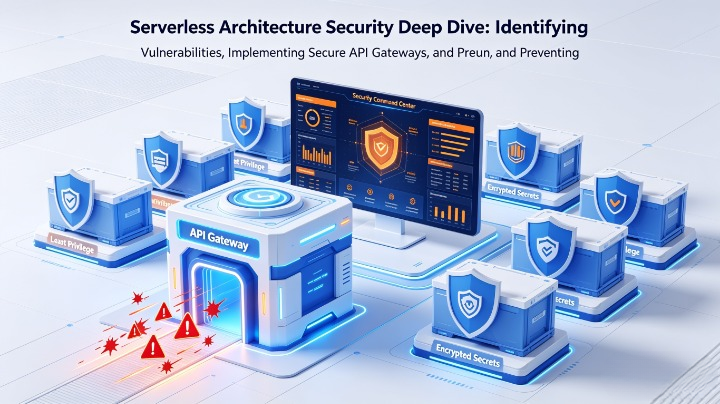
Serverless Architecture Security Deep Dive: Identifying Vulnerabilities, Implementing Secure API Gateways, and Preventing Lambda Function Exploitation
Abstract
Serverless computing — and specifically Function-as-a-Service (FaaS) platforms like AWS Lambda, Azure Functions, and Google Cloud Functions — has revolutionized how organizations build and deploy modern applications. By eliminating the need to provision, manage, or patch underlying servers, serverless architectures reduce operational overhead, accelerate release cycles, and scale automatically to meet demand. However, this operational simplicity introduces profound new security challenges: the shared responsibility model shifts dramatically, attack surfaces become highly dynamic, traditional perimeter defenses become obsolete, and many development teams lack visibility into the underlying risks.
This comprehensive guide provides a deep technical analysis of serverless security, breaking down the unique vulnerabilities that affect FaaS workloads, API gateways, event sources, and integration services. It explains how attackers exploit misconfigurations, overly permissive roles, injection flaws, and insecure dependencies to compromise functions, move laterally across cloud environments, and access sensitive data. It also delivers a step-by-step implementation playbook for securing API gateways, hardening Lambda functions, enforcing least privilege, and building defense-in-depth for serverless stacks. The guide includes real-world exploit examples, compliance mapping, tooling recommendations, and a complete maturity roadmap for organizations migrating to or operating serverless at scale.
1. Introduction: The Security Paradox of Serverless Computing
For decades, application security focused on protecting servers: hardening operating systems, patching vulnerabilities, configuring firewalls, and controlling network access. Serverless computing upends this entire model. When you deploy code to AWS Lambda, Azure Functions, or Cloud Functions, you never see the underlying infrastructure — the cloud provider manages the physical servers, virtualization layer, runtime environment, scaling logic, and operating system updates.
This creates a security paradox: while the provider secures the infrastructure, you face a far more complex, distributed, and fast-changing attack surface that is often invisible to traditional security tools. According to the 2026 Cloud Security Alliance Serverless Security Report, 76% of organizations running serverless applications have at least one critical exploitable vulnerability, and 41% of all serverless functions grant excessive permissions that could allow full account compromise.
1.1 How Serverless Changes the Shared Responsibility Model
The most common cause of serverless security failures is misunderstanding who is responsible for what:
Table
| Layer | Cloud Provider Responsibility | Customer Responsibility |
|---|---|---|
| Physical infrastructure | Data centers, power, cooling, network hardware | None |
| Compute infrastructure | Servers, hypervisors, kernel, OS patching, runtime updates | None |
| Platform management | Scaling, scheduling, isolation, load balancing | None |
| Identity & Access | IAM system availability, authentication infrastructure | IAM policies, roles, permissions, trust boundaries |
| Application layer | Runtime execution environment | Function code, dependencies, environment variables, secrets |
| Integration layer | API Gateway, event source availability | API configuration, authorization, input validation, event filtering |
| Data layer | Storage durability, encryption at rest | Data classification, access controls, encryption keys, data handling |
Critical note: Unlike IaaS or PaaS, you have zero control over the network or host configuration — so you cannot rely on firewalls or host-based agents to protect functions.
1.2 Why Traditional Security Tools Fail on Serverless
Legacy security controls were designed for persistent infrastructure — they do not work for ephemeral, short-lived functions:
- Network firewalls: Functions have no fixed IP address and run in provider-managed VPCs — you cannot create static inbound rules.
- Host antivirus/EDR: No persistent operating system exists to install agents on.
- Vulnerability scanners: Cannot scan running instances that exist for milliseconds.
- Perimeter defenses: Functions are accessed via public APIs or internal event triggers — there is no “inside” or “outside” network.
2. Core Serverless Vulnerabilities: How Attackers Compromise Serverless Environments
Serverless risks differ fundamentally from traditional threats. Below is a technical breakdown of the most dangerous vulnerabilities, how they are exploited, and their real-world impact.
2.1 Overly Permissive Execution Roles
This is the single most common and most dangerous serverless vulnerability — responsible for 60% of all known serverless breaches (Wiz Research 2026).
- How it works: Developers often attach broad managed policies like
AdministratorAccess,AmazonS3FullAccess, orPowerUserAccessto function execution roles to avoid permission errors during testing. These policies grant far more access than the function needs. - Exploit path: If an attacker injects malicious code into the function or tricks it into executing unintended actions, they inherit all permissions of the role — including the ability to create new admin users, delete production data, or exfiltrate entire databases.
- Real example: In 2025, a SaaS startup’s payment processing function used the
AmazonS3FullAccesspolicy. Attackers exploited a code injection flaw to list all buckets, download customer payment records, and delete backups — causing $2.7 million in damages and regulatory fines.
2.2 Insecure API Gateway Configurations
API Gateways are the primary entry point for most serverless applications — misconfigurations here expose functions directly to attackers.
- Missing authentication: APIs are set to “public” or “open” with no requirement for IAM, JWT, or API keys.
- Overly broad resource paths: Wildcards like
/*grant access to every function and method without restriction. - Disabled request validation: No checks for required parameters, data types, or maximum payload size — enabling injection and denial-of-service attacks.
- CORS misconfigurations: Allowing any origin (
*) and credential forwarding lets malicious websites call your API on behalf of users.
2.3 Injection and Deserialization Attacks
Serverless functions process untrusted input from HTTP requests, queues, databases, and third-party APIs — making them prime targets for injection.
- Code injection: Unsanitized input passed directly to
eval(),exec(), or shell commands lets attackers run arbitrary code in the function context. - NoSQL / SQL injection: Functions build database queries dynamically using user input without parameterization.
- Deserialization attacks: Untrusted serialized objects are loaded without validation, executing malicious code embedded in the payload.
2.4 Insecure Dependencies and Supply Chain Risks
Serverless functions rely heavily on open-source libraries — a single vulnerable dependency puts the entire application at risk.
- Outdated libraries: Developers rarely update dependencies after deployment; unlike persistent servers, functions do not receive automatic OS updates, but runtime libraries remain vulnerable.
- Malicious packages: Attackers upload libraries with names similar to popular packages (typosquatting) that steal secrets or open backdoors when imported.
- Hidden vulnerabilities: Transitive dependencies — libraries used by your dependencies — often contain unpatched flaws that scanners miss.
2.5 Hardcoded Secrets and Sensitive Data
Environment variables and function code are often treated as secure storage — but they are not.
- Hardcoded credentials: API keys, database passwords, or encryption keys written directly into code or configuration files are exposed in repositories, build logs, and function metadata.
- Plaintext environment variables: Secrets stored in Lambda environment variables can be retrieved by anyone with permission to view the function configuration — and are included in deployment templates and backups.
- Leaked during execution: In many cases, secrets are logged to CloudWatch or similar monitoring services when errors occur.
2.6 Event Injection and Unsanitized Triggers
Functions can be invoked by multiple sources — S3 uploads, SQS messages, SNS topics, EventBridge rules — creating invisible attack paths.
- Fake events: Attackers that compromise one service can send malicious events to trigger functions with unexpected payloads.
- Event flooding: Sending millions of events triggers thousands of concurrent function invocations, causing denial-of-service and massive unexpected costs.
- Cross-region event abuse: Unrestricted cross-event forwarding lets attackers move threats between environments.
2.7 Broken Function Isolation
While cloud providers isolate functions at the hypervisor and runtime level, design flaws can break isolation:
- Shared mutable storage: Using common S3 buckets, DynamoDB tables, or
/tmpdirectories without access controls lets one function read or modify data from another. - Persistent connections: Reusing long-lived database connections across invocations can leak session state or credentials between unrelated requests.
3. Deep Dive: Securing API Gateways
The API Gateway is your first line of defense — it must block threats before they ever reach your functions. Below is a complete implementation guide for AWS API Gateway, Azure API Management, and Cloud Endpoints.
3.1 Mandatory Authentication and Authorization
Never expose an API without verifying the requester:
- IAM Authentication: Use AWS IAM signatures or Azure AD tokens for internal service-to-service calls.
- JWT / OAuth 2.0: Require valid ID tokens from your identity provider for user-facing APIs — validate issuer, audience, and expiration strictly.
- API Keys: Use only for rate limiting and basic identification — never as the sole authentication method.
- Mutual TLS (mTLS): For high-sensitivity APIs, require clients to present valid X.509 certificates to prove their identity.
3.2 Strict Request Validation
Block malformed or malicious input at the gateway level:
- Define OpenAPI schemas: Specify exactly which methods, paths, parameters, and data types are allowed — reject anything not matching the schema.
- Limit payload size: Restrict maximum request body size to the minimum your application needs (typically 100–500 KB).
- Block dangerous HTTP methods: Disable
TRACE,CONNECT,OPTIONS, and any method your function does not use. - Validate content types: Reject requests with unexpected or ambiguous content types.
3.3 Web Application Firewall (WAF) Integration
Attach a managed WAF to every API stage:
- Enable OWASP Top 10 rule sets to block SQLi, XSS, command injection, and path traversal.
- Add custom rules to block known attack patterns, scanners, and exploit kits.
- Implement rate limiting: Block IPs that send more than 100–500 requests per minute to prevent brute force and DoS attacks.
- Use geo-restrictions: Allow traffic only from countries where your users are located.
3.4 CORS and Origin Controls
- Never use
Access-Control-Allow-Origin: *together withAccess-Control-Allow-Credentials: true. - Explicitly list only trusted domains in allowed origins — do not use wildcards.
- Restrict allowed headers and methods to only what your frontend requires.
- Set strict
max-agevalues to limit preflight request caching.
3.5 Private Integration and Edge Hardening
- Disable public access to backend functions: Use resource policies to allow invocation only from your API Gateway.
- Use private endpoints: Connect API Gateway to functions via VPC or private integrations instead of public URLs.
- Add request IDs and tracing: Log every request with a unique ID to track malicious activity end-to-end.
4. Hardening Lambda and Serverless Functions: Complete Exploitation Prevention
Even with a secure gateway, functions themselves must be hardened to resist compromise. Below are technical controls to prevent exploitation.
4.1 Enforce Absolute Least Privilege
This is the most critical control for stopping privilege escalation:
- Remove all managed policies: Never use pre-built policies like
AmazonS3FullAccess— write custom policies that grant only the exact actions and resources needed. - Restrict by resource: Instead of
"Resource": "*", specify exactly which ARNs the function can access. - Restrict by condition: Add conditions to limit permissions by source IP, MFA status, or request time.
- Use permission boundaries: Set a maximum permission ceiling for all roles — even if a developer adds extra permissions, the boundary prevents exceeding the allowed limit.
- Zero trust execution: Start with zero permissions and add only what is strictly required.
Example of Bad vs Good Policy:
❌ Bad: Grants access to all buckets
json
"Effect": "Allow",
"Action": ["s3:*"],
"Resource": "*"
✅ Good: Grants only read access to exactly one bucket
json
"Effect": "Allow",
"Action": ["s3:GetObject"],
"Resource": "arn:aws:s3:::payment-reports-prod-123/*",
"Condition": {"StringEquals": {"s3:ResourceAccount": "123456789012"}}
4.2 Secrets Management: Eliminate Hardcoding
- Never store secrets in environment variables or code: Use dedicated secrets managers — AWS Secrets Manager, Azure Key Vault, Google Secret Manager — with short-lived access.
- **Grant only
secretsmanager:GetSecretValuepermission to exactly the secret ARN the function needs. - Rotate secrets automatically: Configure providers to rotate credentials without code changes.
- Encrypt environment variables: Use KMS keys to encrypt any non-secret configuration values — never store plaintext PII or API keys.
4.3 Code and Dependency Security
- Scan before deployment: Run SCA (Software Composition Analysis) tools like
npm audit, Snyk, or Trivy in CI/CD — block deployments with critical vulnerabilities. - Pin dependency versions: Avoid
latestor floating version numbers — ensure every deployment uses exactly the same tested code. - Minify and obfuscate: Remove debug code, comments, and unused files to reduce exposed attack surface.
- Use signed images: Deploy only from verified container images or signed deployment packages.
4.4 Runtime and Execution Controls
- Disable unused features: Turn off runtime debug modes, introspection tools, and shell access entirely.
- Limit execution duration: Set function timeout to the shortest possible value — never use the maximum 15-minute limit unless absolutely necessary.
- Restrict file system access: The
/tmpdirectory is shared — limit write permissions and never store sensitive data there. - Network isolation: Run functions in dedicated VPCs with no public internet access unless explicitly required — use VPC endpoints for AWS service calls instead of public APIs.
- Environment hardening: Remove unnecessary system binaries, limit process creation, and disable network sockets where possible.
4.5 Input Validation and Output Encoding
- Validate all input: Treat every event field — HTTP body, query parameters, message content — as untrusted. Use strict schema validation with libraries like Joi, Zod, or Pydantic.
- Reject invalid input: Return clear errors immediately — never attempt to “fix” or sanitize malicious input.
- Parameterize all queries: Never concatenate user input directly into SQL, NoSQL, or API calls.
- Encode output: Escape data before returning it to prevent injection in downstream systems.
4.6 Blocking Common Exploit Paths
- Disable dangerous functions: Block
eval(),Function(),child_process,exec(), and similar dynamic code execution features. - Restrict outbound network access: Allow only specific domains or IPs — use a NAT gateway with strict allowlists.
- Avoid dynamic imports: Never load modules based on user input — attackers can force loading of malicious files.
- Validate event sources: Include checks to confirm events come from expected services and ARNs — reject unrecognized triggers.
5. Additional Serverless Security Controls
5.1 Build and Deployment Pipeline Security
- Immutable deployments: Never edit running function code — deploy new versions only through CI/CD.
- Approval gates: Require security team approval before deploying functions with broad permissions.
- Sign artifacts: Use Sigstore or similar tools to verify that code has not been tampered with during delivery.
5.2 Logging, Monitoring, and Threat Detection
- Centralized logging: Send all function logs, API access logs, and error traces to a SIEM with immutable storage.
- Enable guardrails: Use AWS Config, Azure Policy, or Organization Policies to block risky configurations automatically.
- Anomaly detection: Alert on unusual patterns — sudden spikes in invocations, errors calling new services, or changes to IAM roles.
- Audit continuously: Scan for public functions, missing encryption, and overly permissive policies daily.
5.3 Supply Chain and Compliance
- Generate SBOMs: Include a Software Bill of Materials for every deployment to track all dependencies.
- Map to regulations: Serverless controls must align with GDPR, HIPAA, PCI DSS, and local laws — ensure audit logs are retained for required periods.
- Penetration testing: Conduct regular red team exercises specifically targeting serverless APIs and event flows.
6. Real-World Case Study: Securing a Serverless Fintech Platform
Organization: A digital wallet provider processing 2.3 million transactions daily on AWS Lambda and API Gateway.
Initial State: 120+ functions using broad managed policies, open APIs, and hardcoded secrets — security teams had zero visibility into risks.
Implementation:
- Removed all managed policies and rewrote every role with least privilege.
- Integrated AWS WAF and JWT authentication across all APIs.
- Migrated all secrets to Secrets Manager and encrypted all environment variables.
- Added pre-deployment dependency scanning and schema validation.
- Enforced VPC isolation and disabled public access to functions. Result: Critical vulnerabilities dropped from 89 to zero; API abuse incidents fell by 97%; compliance audit passed with zero findings.
7. Serverless Security Maturity Roadmap
Table
| Stage | Focus | Key Milestones |
|---|---|---|
| Basic | Visibility & Access | Inventory all functions; enable logging; remove full-access policies |
| Standard | Hardening | Secure API Gateway; migrate secrets; validate all input |
| Advanced | Defense-in-Depth | VPC isolation; WAF integration; automated guardrails |
| Optimized | Continuous Assurance | Zero-trust policies; SBOM scanning; serverless red teaming |
8. Conclusion
Serverless architecture offers unmatched speed and scalability — but it does not eliminate security responsibility, it shifts it. The most dangerous assumption is that “the provider handles security” — attackers know better, and they actively target the gaps teams leave behind.
Securing serverless requires a complete shift in mindset: you cannot rely on infrastructure defenses — you must secure code, permissions, APIs, and trust relationships. By eliminating overprivilege, hardening entry points, validating every input, and treating every function as potentially compromised, you can build serverless applications that are not only faster and cheaper, but far more secure than traditional systems.
Security in serverless is not a one-time fix — it is embedded into every line of code, every permission, and every deployment.