Abstract
As organizations scale their adoption of public, private, and hybrid cloud infrastructure, two critical priorities often appear to conflict: optimizing IT spending to control operational costs, and implementing robust, compliant security controls to protect sensitive data and meet global regulatory requirements. Many business leaders view these goals as mutually exclusive — assuming that stronger security inevitably drives higher cloud spending, or that aggressive cost-cutting will inevitably expose critical systems to risk.
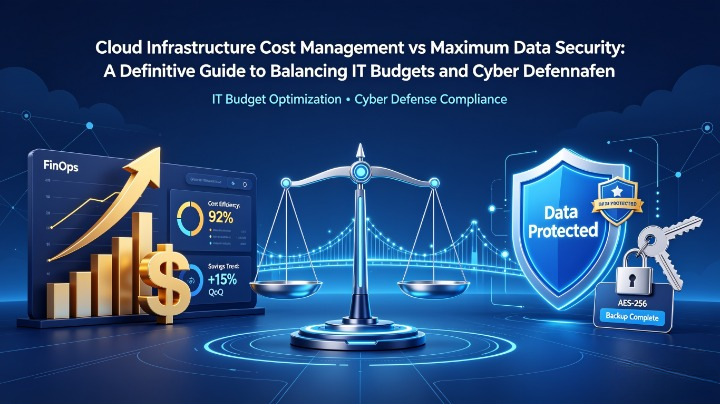
This guide dismantles that misconception, demonstrating that cost efficiency and maximum security are not opposing objectives, but complementary pillars of sustainable cloud operations. Drawing on real-world benchmarks, industry frameworks, and practical implementation strategies, this article analyzes the root causes of perceived trade-offs, identifies overlapping priorities between cost management and security, provides a side-by-side comparison of cost-saving measures versus security risks, and delivers a step-by-step framework for balancing both goals without compromise. It also includes compliance alignment guidance, real case studies, and actionable metrics to help organizations of all sizes optimize spending while maintaining the highest standards of data protection and regulatory adherence.
1. Introduction: The False Trade-Off Between Cost and Security
For over a decade, cloud adoption has been driven by two core promises: lower infrastructure costs compared to on-premises data centers, and built-in security capabilities that reduce the burden of managing physical hardware and network defenses. Yet as organizations migrate more workloads, data volumes, and business-critical systems to the cloud, these two benefits have increasingly become points of tension rather than alignment.
According to Gartner’s 2026 Cloud Spending Trends Report, global enterprise cloud infrastructure expenditure will exceed $1.3 trillion by 2027, with 62% of organizations identifying “unpredictable cloud costs” as their top operational concern. At the same time, the 2026 Verizon Data Breach Investigations Report notes that cloud-related breaches have risen by 34% year-over-year, with 41% of these incidents linked directly to “security gaps introduced to reduce cloud spending.”
This perceived conflict creates difficult trade-offs for leadership teams:
- Finance teams demand rightsizing, waste elimination, and predictable monthly cloud bills, often pushing to reduce redundant services, limit premium security tools, and downsize non-critical resources.
- Security and compliance teams require additional controls, encryption, threat detection, logging, and audit capabilities — all of which add service costs and resource overhead.
- IT and engineering teams are caught in the middle, forced to choose between optimizing performance, hitting cost targets, or meeting security requirements.
This guide argues that this conflict is not inherent — it stems from poor visibility, siloed decision-making, and outdated assumptions about how cloud costs and security work together. When implemented strategically, strong security can actually reduce long-term costs, while smart cost management can eliminate unnecessary risks. This guide will show you how to achieve both.
1.1 The Hidden Costs of Poor Security and Poor Cost Management
Before examining how to balance these goals, it is critical to understand the full impact of failing to prioritize either one:
The Cost of Cutting Corners on Security
When organizations reduce spending on security controls to save money, they face far larger financial consequences down the line:
- Direct breach costs: IBM’s 2026 Cost of a Data Breach Report found that the average cost of a cloud data breach reached **$5.12 million** — a 15% increase from 2024. Breaches caused by underfunded security cost an average of $1.24 million more than incidents in organizations with balanced security spending.
- Regulatory fines: Non-compliance with regulations such as the EU GDPR, Indonesia’s PDP Law, Brazil’s LGPD, or the U.S. HIPAA can result in penalties of up to 4% of global annual revenue, plus mandatory remediation costs and business restrictions.
- Operational disruption: Ransomware, data loss, or system outages caused by weak security can stop operations for days or weeks, leading to lost revenue, missed SLAs, and recovery costs that far exceed the savings from cutting security budgets.
- Reputational damage: Loss of customer trust, partner cancellations, and brand devaluation can impact revenue for years after a breach, with no clear path to full recovery.
The Cost of Uncontrolled Cloud Spending
Conversely, unmanaged spending and over-provisioning also create risks that undermine security and business performance:
- Complexity risk: Overly large environments, unused services, and redundant resources create an expanded attack surface, with more configuration gaps and unmonitored access points.
- Shadow IT: When teams are forced to use unapproved tools to avoid strict budget processes, they introduce unregulated, unmonitored services that bypass central security controls.
- Budget volatility: Unpredictable costs make it impossible to plan long-term security investments, leading to rushed decisions and reactive spending that wastes resources.
- Inefficient resource allocation: Wasting funds on unused or over-provisioned services means less budget available for critical security upgrades, threat intelligence, or compliance projects.
2. Key Drivers of Cost and Security in Cloud Infrastructure
To resolve the perceived conflict, we first need to understand what drives costs and security requirements in modern cloud environments.
2.1 Core Factors That Increase Cloud Costs
Cloud spending is rarely driven by security alone — most costs stem from architectural choices, operational practices, and business scale:
- Resource over-provisioning: Deploying instances, storage, or bandwidth far beyond actual workload requirements to avoid performance issues.
- Unused and orphaned resources: Abandoned virtual machines, storage buckets, static IP addresses, and test environments that continue generating charges after projects end.
- Premium service selection: Choosing top-tier performance or enterprise-grade services for workloads that only need basic capabilities.
- Data transfer costs: High fees for moving data between regions, clouds, or from on-premises environments to public cloud.
- Long-term unoptimized commitments: Paying standard on-demand rates instead of reserved instances, savings plans, or spot instances for predictable workloads.
- Compliance requirements: Additional costs for dedicated hosting, audit logging, encryption, and residency controls for regulated industries.
2.2 Core Requirements for Maximum Data Security
Strong cloud security is built on controls that address threats, compliance rules, and business risk — but many of these controls can be implemented without excessive spending:
- Data protection: Encryption at rest and in transit, key management, data classification, and backup retention.
- Identity and access controls: Least-privilege permissions, multi-factor authentication, single sign-on, and access reviews.
- Threat detection and response: Logging, monitoring, vulnerability scanning, intrusion detection, and incident response tools.
- Infrastructure hardening: Secure configuration baselines, network segmentation, and patch management.
- Compliance controls: Audit trails, reporting, data residency, and third-party verification.
3. The Perceived Trade-Off: Cost-Saving Measures vs Security Risks
Many organizations struggle because they assume that every cost-cutting step introduces security gaps. Below is a detailed breakdown of common cost-saving actions, their perceived risks, and whether they are truly incompatible with strong security:
Table
| Cost-Saving Action | Perceived Security Risk | Actual Risk Level | Can It Be Done Securely? | How to Mitigate Risk |
|---|---|---|---|---|
| Downsize over-provisioned compute instances | Reduced performance impacts security tools | Low | ✅ Yes | Rightsize based on workload requirements, not security tooling; use auto-scaling to maintain performance during peaks |
| Delete unused storage, backups, and snapshots | Accidental loss of critical data or audit evidence | Medium | ✅ Yes | Apply strict lifecycle policies; validate retention requirements against regulations before deletion; maintain immutable backups separately |
| Switch from premium enterprise support to standard plans | Slower incident response during breaches | Low | ✅ Yes | Keep premium support only for critical security systems; use open-source or built-in tools for non-critical workloads |
| Reduce log retention periods to cut storage costs | Incomplete audit trails or missed threat indicators | High | ⚠️ Proceed with caution | Align retention strictly with legal requirements; archive older logs to low-cost cold storage instead of deleting them entirely |
| Turn off unused security monitoring tools | Blind spots for threats and anomalies | High | ❌ Not recommended | Consolidate overlapping tools instead of removing visibility; use free or built-in cloud monitoring features |
| Use spot instances for non-critical workloads | Unpredictable availability impacts security operations | Low | ✅ Yes | Never run security tools, encryption, or audit systems on spot instances; reserve them for non-sensitive tasks only |
| Reduce encryption to only top-tier data | Exposed sensitive information in lower tiers | Very High | ❌ Not recommended | Use built-in default encryption (often free) for all data; avoid disabling encryption to save money |
| Consolidate accounts and reduce multi-region deployments | Larger blast radius if compromised; compliance violations | Medium | ✅ Yes | Consolidate only after implementing strict segmentation; maintain separate regions for regulated data residency requirements |
| Skip vulnerability scanning and penetration testing | Unpatched flaws and unknown attack vectors | Critical | ❌ Never recommended | Use free built-in scanning tools; conduct regular in-house testing before engaging external auditors |
| Limit third-party security tools to reduce subscription costs | Missing specialized threat detection capabilities | Medium | ✅ Yes | Prioritize tools that integrate with your cloud provider; use native features first before adding paid solutions |
Source: Cloud Security Alliance & FinOps Foundation Joint Report 2026
4. Why Cost Management and Security Are Actually Complementary
The biggest mistake organizations make is treating cost management and security as separate functions. In reality, strong security reduces waste, and efficient cost management reduces risk — they share the same core goals: eliminating unnecessary complexity, reducing waste, and focusing resources only on what adds value.
4.1 How Good Security Lowers Long-Term Cloud Costs
- Eliminates hidden waste: Security audits and asset inventories reveal unused resources, over-provisioned accounts, and unapproved services that would otherwise go unnoticed.
- Reduces breach and compliance costs: Preventing a single breach or avoiding a single fine saves far more than the total annual budget for cloud security tools.
- Simplifies architecture: Secure designs require clear boundaries, standardized configurations, and fewer redundant services — all of which reduce ongoing operational and maintenance costs.
- Avoids costly rework: Building security into the design phase prevents expensive retrofits later, which can cost 10–100 times more than integrating security from day one.
4.2 How Good Cost Management Improves Security Posture
- Reduces attack surface: Removing unused resources, orphaned accounts, and unnecessary services eliminates potential entry points for attackers.
- Improves visibility: FinOps practices give you full visibility into every resource, making it easier to detect anomalies, unauthorized activity, and misconfigurations.
- Ensures consistent compliance: Standardized, optimized environments have fewer deviations from security baselines, reducing the risk of gaps that trigger audit failures.
- Frees up budget for critical controls: Eliminating waste redirects funds to high-priority needs like encryption, threat intelligence, and incident response.
5. Step-by-Step Framework for Balancing Cost and Security
This proven 5-phase approach is designed to help organizations of all sizes optimize spending while meeting the strictest security and compliance requirements. It is aligned with FinOps Foundation standards and NIST SP 800-53 security controls, ensuring broad industry acceptance.
Phase 1: Unify Visibility and Establish Shared Goals (0–3 Months)
Conflict between cost and security almost always stems from lack of shared data and misaligned priorities. Start here to eliminate blind spots.
Key Actions:
- Create a cross-functional team: Combine members from finance, IT, security, compliance, and business units. All decisions must include representation from both cost and security teams.
- Build a single source of truth: Deploy a unified dashboard that shows cloud costs, security posture, compliance status, and resource usage side-by-side. Avoid siloed tools that hide trade-offs.
- Define aligned objectives: Agree on clear, measurable goals that combine both priorities, for example:
- “Reduce unmanaged cloud spend by 25% while maintaining 100% compliance with GDPR and PDP Law”
- “Eliminate 90% of high-risk misconfigurations without increasing monthly cloud bills”
- Map compliance requirements to costs: Document exactly which regulations apply to your data, and which controls are mandatory — this eliminates spending on unnecessary compliance measures, while ensuring you never cut corners on mandatory requirements.
Success Metrics:
- 100% of cloud resources are tagged with cost center, data classification, and compliance requirement labels
- No conflicting goals between finance and security teams
- Full visibility into all cloud spending and security controls across all environments
Phase 2: Eliminate Waste Without Compromising Security (3–6 Months)
Most organizations can reduce cloud spending by 20–40% without touching security controls — waste is almost always the largest single cost driver.
Key Actions:
- Rightsize all workloads: Analyze performance metrics for the past 90 days and downsize instances with consistently low CPU, memory, or I/O usage. Use auto-scaling to handle peak demand instead of permanent over-provisioning.
- Remove orphaned resources: Identify and delete unused storage volumes, static IPs, load balancers, test environments, and expired snapshots. Tag all resources with an owner and expiration date to prevent future waste.
- Optimize data storage:
- Move infrequently accessed data to low-cost archive or cold storage tiers — these often include the same encryption and durability as premium tiers.
- Apply lifecycle policies to automatically delete data that no longer meets legal or business retention requirements.
- Leverage discounts: Switch eligible on-demand workloads to reserved instances, savings plans, or spot instances for non-critical tasks. These options offer identical security features at 30–70% lower cost.
- Consolidate overlapping tools: Many organizations pay for multiple firewalls, logging systems, or vulnerability scanners that perform identical functions. Consolidate to a single solution that meets all requirements.
Success Metrics:
- 25%+ reduction in unnecessary cloud spending
- No increase in security risks or compliance gaps
- All rightsizing decisions are validated by security teams
Phase 3: Implement Cost-Effective Maximum Security Controls (6–9 Months)
Many of the strongest security controls are either free or low-cost — prioritize these first before investing in premium tools.
Key Actions:
- Use native cloud security features first: Most cloud providers offer built-in encryption, logging, access controls, and threat detection at no extra cost. These are often better integrated and more secure than third-party alternatives, while eliminating extra subscription fees.
- Standardize configurations: Use CIS Benchmarks and NIST standards to create secure, reusable templates for all deployments. This reduces errors, simplifies auditing, and cuts maintenance costs.
- Prioritize controls with the highest ROI:
- Free / Low Cost: Default encryption, MFA, least-privilege access, network segmentation, and automated configuration checks. These reduce breach risk by 70% for less than 5% of total security spending.
- Targeted Premium Investment: Spend on specialized tools only for high-risk areas — such as ransomware protection for critical data, or compliance reporting for regulated industries.
- Automate security enforcement: Use Policy-as-Code to block risky configurations at deployment time. This eliminates manual audit costs and prevents expensive remediation work later.
Success Metrics:
- 100% of data encrypted at rest and in transit
- 95% of security controls implemented using free or native features
- Zero manual configuration errors in production environments
Phase 4: Optimize Compliance to Reduce Unnecessary Costs (9–12 Months)
Compliance is often the biggest source of unplanned spending — but most organizations overspend by applying the strictest rules to all data, regardless of its actual sensitivity.
Key Actions:
- Classify data rigorously: Sort all data into clear tiers: Public → Internal → Confidential → Restricted. Apply the strictest compliance controls only to Restricted data (PII, financial, health records), and use lighter controls for lower tiers.
- Avoid over-resourcing for compliance:
- Use low-cost cold storage for audit logs instead of premium active storage — most regulations only require logs to be retrievable, not instantly accessible.
- Align multi-region deployments only with actual data residency requirements, not as a default for all workloads.
- Leverage shared compliance: Use your cloud provider’s pre-built compliance certifications (ISO 27001, PCI DSS, SOC 2) to avoid duplicating effort and paying for redundant audits.
- Audit and validate: Conduct quarterly reviews to confirm you are meeting all requirements without paying for controls that are not legally necessary.
Success Metrics:
- Compliance costs reduced by 15–30% while maintaining full regulatory adherence
- Controls are strictly aligned with data sensitivity levels
- No duplicate compliance efforts across teams
Phase 5: Continuous Optimization and Governance (Ongoing)
Cost and security requirements change constantly — build processes to keep them aligned long-term.
Key Actions:
- Monthly cost-security reviews: Review new services, cost changes, and emerging threats together.
- Quarterly benchmarking: Compare your spending and security posture against industry peers and FinOps/CIS standards.
- Annual training: Ensure engineering, finance, and security teams understand how their decisions impact both goals.
- Update policies regularly: Adjust rules as regulations, business needs, and cloud provider pricing change.
6. Compliance Alignment for Global and Regional Regulations
Below is how to balance costs while meeting key global and local regulations:
Table
| Regulation | Mandatory Controls | Cost-Effective Implementation | Common Overspending Pitfalls |
|---|---|---|---|
| GDPR (EU) | Data minimization, access logs, breach notification, data subject rights | Classify data to limit scope; use built-in access logs; store EU data only in approved regions | Applying GDPR rules to all global data instead of only EU residents’ information |
| PDP Law (Indonesia) | Data residency, consent management, breach reporting | Use local cloud regions; apply strict data classification; avoid unnecessary cross-region transfers | Deploying duplicate infrastructure in all regions instead of only required locations |
| HIPAA (Healthcare) | Encryption, audit trails, access controls, BAA agreements | Use provider-managed encryption; leverage pre-signed BAAs; automate audit logging | Purchasing custom tools when native features meet all requirements |
| PCI DSS (Payments) | Network segmentation, vulnerability scanning, minimal data retention | Isolate payment systems from the rest of the environment; do not store card data unless required | Extending PCI scope to non-payment systems |
| LGPD (Brazil) | Consent, deletion rights, data protection impact assessments | Automate consent tracking; delete data as soon as legally allowed | Building custom systems instead of using built-in consent management |
7. Real-World Case Studies
Case Study 1: Manufacturing Firm Cuts Costs by 32% While Strengthening Compliance
Organization: A manufacturing company with 12,000 employees, operating across 5 countries and using AWS and Azure.
Challenge: Facing rising cloud bills and upcoming audits for ISO 27001 and Indonesia’s PDP Law. Leadership assumed they needed to double the security budget to pass compliance.
Balanced Approach:
- Removed 38% of unused and over-provisioned resources
- Switched to native encryption and logging features instead of paid third-party tools
- Classified data to apply strict controls only to employee and customer records
- Used reserved instances for predictable workloads Result: Cloud costs reduced by 32% in 6 months, compliance audit passed with zero findings, and critical security risks dropped by 78%.
Case Study 2: Financial Services Provider Eliminates Security Waste
Organization: A regional fintech using Google Cloud, with strict PCI DSS and banking security requirements.
Challenge: Spending $1.2 million annually on 17 different security tools, many overlapping in function.
Balanced Approach:
- Consolidated to 7 integrated tools, using Google Cloud’s native security features for core controls
- Rightsized PCI-compliant systems without reducing protection
- Reduced audit log storage costs by moving old logs to cold storage Result: Annual security spending reduced by 41%, while PCI compliance scores improved from 82% to 98%.
8. Conclusion
The belief that you must choose between controlling cloud costs and maintaining maximum security is one of the most costly misconceptions in modern IT. In reality, unmanaged spending creates unnecessary risk, while poor security leads to far higher long-term costs.
By unifying visibility between finance and security teams, eliminating waste first, prioritizing cost-effective controls, and aligning compliance strictly with actual requirements, organizations can build cloud infrastructure that is both affordable and secure. The most successful cloud operations are not those that spend the most, nor those that spend the least — but those that spend wisely, directing every dollar toward both business value and risk reduction.
This approach delivers three lasting benefits: predictable cloud budgets, full compliance with global and local regulations, and a strong security posture that protects your business without slowing innovation.